
In Senegal, three columnists close to Pastef are being judged for offending the head of state.
Three commentators from the media outlet Feeñal Digital, close to the Pastef party, will appear in front of Senegalese justice on Wednesday for insulting the head of state and making statements contrary to public morals. Lamignou Darou, Oustaz Thiep, and Ndiaye Touba are being prosecuted following the dissemination of a video on TikTok in which they prayed for misfortune and death to strike “those who betrayed the Pastef project.”

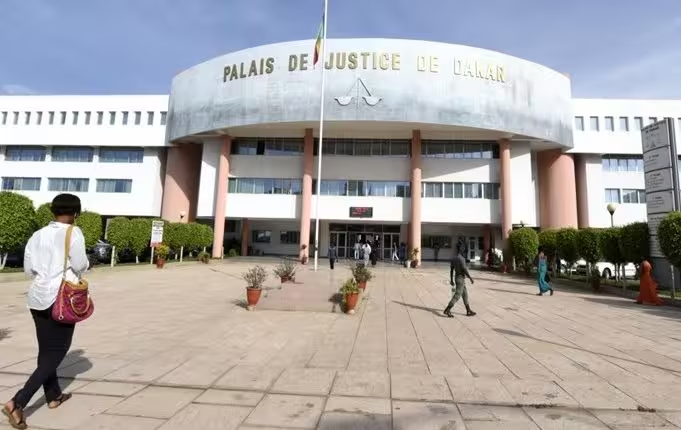
The wording has been widely interpreted as targeting President Bassirou Diomaye Faye, even though his name is not mentioned in the video. The three men, arrested on July 28 at their editorial office, have been detained since that date and are being tried urgently, following a self-referral by the public prosecutor.
The defendants assured investigators that they were not targeting the head of state. They presented the sequence as a discussion among friends, without the intention of attacking the President of the Republic.
Their lawyer, Me Aby Nar Ndiaye, contests the classification made by the prosecution. According to him, the offense of insulting the head of state can only be constituted if the president is explicitly identified, unlike defamation, which can, in some cases, be upheld without direct citation of the person’s name being targeted.
The defense denounces political persecution
The defense also seeks to place this procedure within a broader political context. They denounce an alleged persecution aimed at the youth who support Ousmane Sonko, President of the Pastef party and current President of the National Assembly.
Relations between the head of state and Mr. Sonko have soured since the latter was dismissed from the Prime Minister’s office in May. The defense believes that this rivalry fuels the prosecutions against supporters of Pastef, especially on social media.
The three commentators face sanctions for statements deemed contrary to public morals as well as for insulting the head of state. Their counsel is pleading for their release, arguing that the elements constitutive of the offense are not present.
This case arises just days after the conviction of Adama Ndiaye, a merchant from Touba, who was sentenced to six months in prison, one of which is mandatory, for remarks made against the president during a live session on TikTok. This precedent is invoked in the debate regarding the repression of speech broadcast on digital platforms in Senegal.
Related Articles
 Somalia: 26,000 displaced from Baidoa face famine risk by December
 2nd edition of the Mangal Festival: science, culture, and local knowledge mobilized to preserve the Mono Delta
 In Gabon, enrollment for digital driving licenses suspended three days before deadline
 Benin: 54 million FCFA in equipment to monitor displaced populations
Comments
Comments load when you reach this section.