
World Cup 2026: why Senegalese players were checked on an American tarmac
Images of players from the Senegal national team undergoing security checks on the tarmac of an American airport sparked numerous reactions on social media. Some users presented it as an embarrassment inflicted on the Lions of Teranga upon their arrival in Texas, but the Senegalese Football Federation ultimately provided context for the scene.

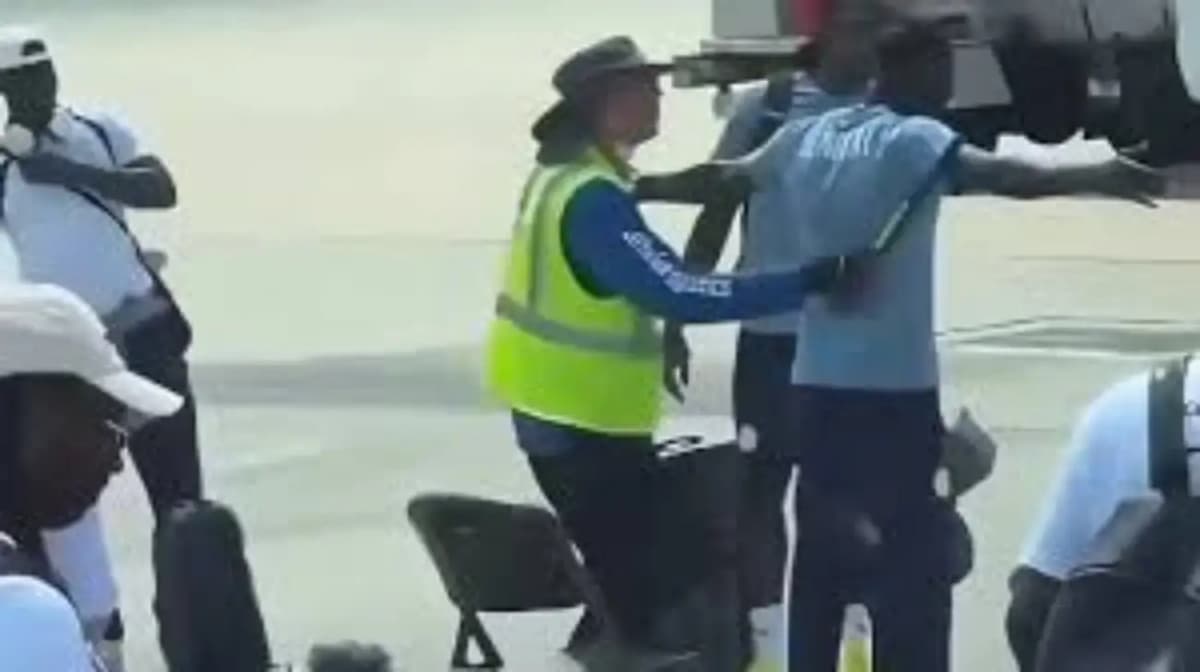
The viral videos show several members of the delegation being checked with metal detectors, while luggage is also inspected on the tarmac. These images, filmed outdoors, quickly provoked outrage among some members of the public, with some criticizing the welcome as unworthy for an African team.
According to the viral videos, the Senegalese players and their staff were subjected to additional security checks, a procedure seen as excessive and discriminatory. A treatment that, for instance, some other delegations who faced the same entry formalities into the U.S. did not experience. The outrage quickly transcended the borders of the African continent, putting pressure on FIFA and the American organizers.
In light of the controversy, Western media attempted to defuse the situation by explaining that it was not an act of discrimination but a “privilege” procedure aimed at speeding up the players’ boarding for a domestic flight. This version attracted a lot of commentary, especially after images were broadcast showing the athletes treated “like criminals,” to use the expression cited by several international media.
The scene took place in Raleigh
Contrary to what was initially claimed in several viral posts, the checks did not occur upon the Senegalese delegation’s arrival in Texas. They took place at Raleigh airport, just before departing for San Antonio, where the Lions were to continue their training.
The Senegalese Football Federation explains that the delegation was taken directly from its hotel to the tarmac, without passing through the regular terminal. This arrangement, according to the FSF, aimed to facilitate boarding onto the private flight and to avoid the players and staff having to transit through the usual airport areas.
Under these conditions, the security and police checks were conducted directly at the foot of the airplane. The Federation emphasizes that this procedure complied with existing airport security regulations.
The FSF cites a standard procedure
In response to the controversy, the Senegalese Football Federation sought to downplay the incident. In its statement, it clarifies that no particular incident was reported during the operation and that the private flight from Raleigh to San Antonio went smoothly.
A member of the Federation, quoted by the French press, also referred to a “standard check,” assuring that the Senegalese team had been “very well treated.” This version contradicts the initial interpretations that portrayed the scene as a targeted humiliation upon the team’s descent from the plane in Texas.
The FSF emphasizes that the decision to carry out the checks on the tarmac was based on logistical organization. The aim was to save time, facilitate the movement of the group, and ensure boarding under good conditions for a private flight.
A controversy amplified by social media
The controversy primarily stemmed from the perception of the images. Seeing players being checked outdoors, in the sun, at the foot of an airplane shocked many internet users. In a context where issues of differential treatment of African teams are often sensitive, the video was quickly interpreted as a sign of disdain.
However, the clarifications provided by the Senegalese Federation and the verifications published since have helped correct several points. The scene did not happen in San Antonio, it did not occur upon the team’s arrival, and it does not correspond to an arrest or an exceptional measure targeting the Lions of Teranga.
Similar checks can be organized for other delegations traveling on private flights, especially when teams are taken directly to the tarmac to avoid the usual airport routes. In such cases, security procedures remain mandatory, even if they are carried out outside the terminal.


Comments
Comments load when you reach this section.