
Benin goes on the offensive to push its cotton production beyond 700,000 tons.
The Beninese government promises an exceptional bonus of 10 FCFA per kilogram to cotton producers if national production exceeds 700,000 tons during the 2026-2027 campaign. This measure, estimated at around 7 billion FCFA, aims to revive a cotton sector that has been in decline for three campaigns and to bring Benin back to its best production levels.

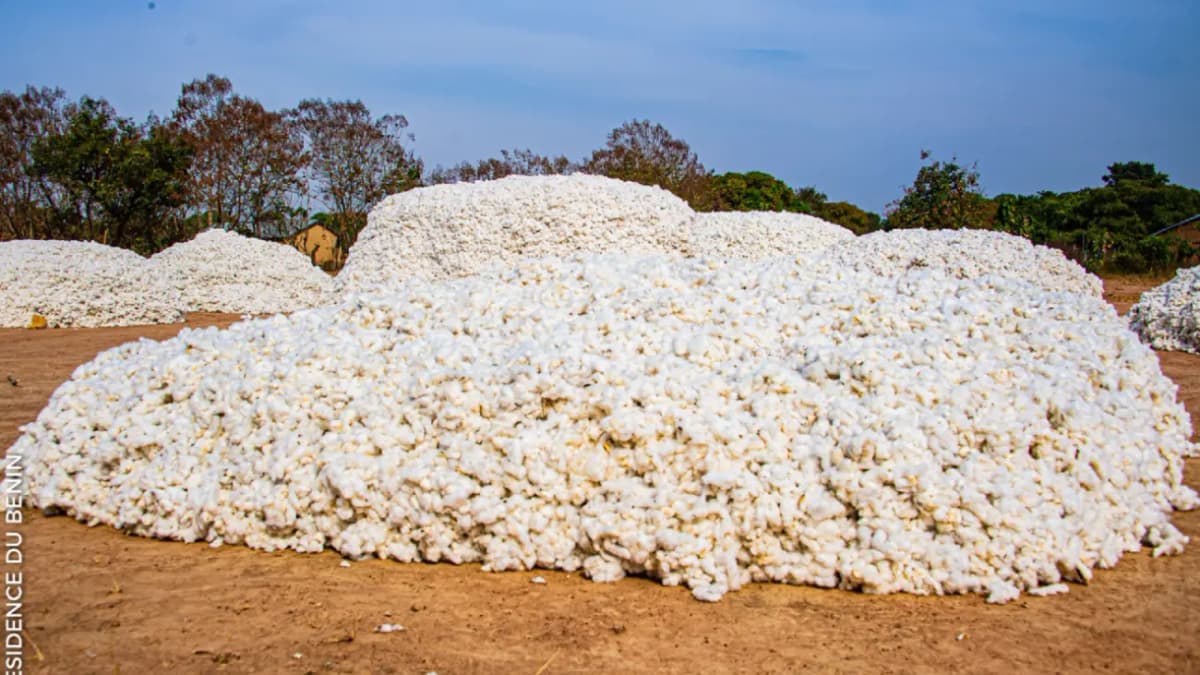
The Beninese government will pay cotton producers an exceptional bonus of 10 CFA francs per kilogram, in addition to the approved purchase price if national production exceeds 700,000 tons during the 2026-2027 campaign. The corresponding budget is estimated at about 7 billion CFA francs, or nearly 10.7 million euros. This measure, approved by the Council of Ministers on June 3, was highlighted on Friday, June 12, in Parakou during the annual cotton producers’ celebration organized by the Interprofessional Cotton Association (AIC).
As the largest cotton producer in West Africa, Benin has seen its volumes decline over the past three campaigns, dropping from over 700,000 tons to about 500,000 tons. Authorities attribute this decrease to irregular rainfall, inconsistent seed quality, insufficiently adapted agricultural advice, and limited mechanization. The target of 700,000 tons corresponds to the levels reached before this decline.
An expanded system for four sectors
The cotton bonus is part of a set of measures decided on June 3 in favor of the cotton, soybean, rice, and cashew sectors. For cotton, the payment is contingent upon exceeding the production threshold of 700,000 tons. For the other three sectors, the bonus of 10 CFA francs per kilogram is subject to the delivery of production to local processing units, once the established capacities are met, set at 200,000 tons for cashew, 450,000 tons for soybean, and 350,000 tons for rice.
The mechanism is thus linked to the overall performance of each sector rather than to systematic support. The government presents this system as a way to increase farmers’ incomes and secure supply for local factories, complementing the ban on exporting certain raw materials intended for national processing.
The implementation falls to the Minister of Agriculture, Livestock, and Fisheries, Adin Yeton Bloukounon Goubalan, who has held numerous consultations with stakeholders in the sector, including the AIC, the Cotton Development Company (Sodeco), the National Federation of Village Cooperatives of Cotton Producers, and the Territorial Agricultural Development Agency of Pole 2.
Cotton remains Benin’s primary export crop and a major source of foreign exchange for the country. Operations for the 2026-2027 campaign began in April 2026, and it will be at the end of this period that the achievement of the threshold qualifying for the bonus will be assessed.



Comments
Comments load when you reach this section.