
WACA: Coastal states meet in Cotonou to strengthen resilience against climate threats
In the wake of a year marked by accelerating coastal erosion in West Africa, representatives of the coastal countries met this Thursday, December 4, 2025, in Cotonou to think together about the most effective responses. Ministers, experts, donors and technical actors discussed strategies to adopt to strengthen communities’ resilience and protect threatened coastal areas.
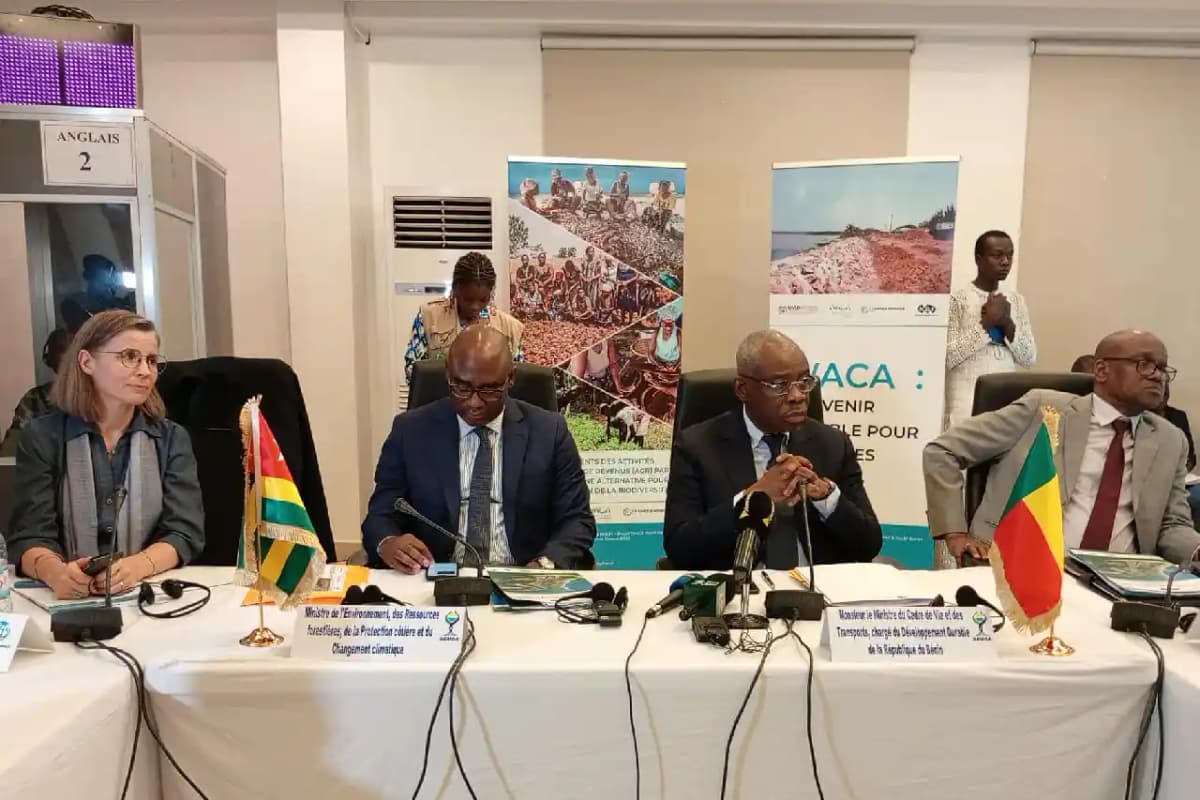
The 2nd meeting of 2025 of the Regional Steering Committee of the Investment Program for the Resilience of Coastal Areas in West Africa (WACA ResIP) provided a platform for strong voices convinced that only collective action will contain the impacts of climate change.
The meeting allowed participants to review the achievements of the program’s first phase, but also to identify persistent challenges. In his opening remarks, Benin’s Minister of Living Environment and Sustainable Development, José Didier Tonato, warned against the risk of downplaying the human causes of climate disruption. He reminded attendees that “we often forget, we point at climate change, but we forget that behind climate change are the actions we take every day.”
In his speech, the Beninese minister also called for a deep change in behavior across West Africa. Wanting to anchor states’ actions in a sustainable dynamic, he stressed the need to root a new environmental culture. “At some point, we need to get used to saying that we have overcome this fatalism and that our habits have integrated the culture of living with nature in harmony,” he said. He urged governments to go beyond one-off interventions.
Cooperation essential for shared challenges
Continuing his remarks, José Didier Tonato praised the ongoing collaboration among the WACA ResIP member countries. He highlighted the exemplary scope of certain works carried out in Benin, notably in Grand-Popo. “The implementation of the WACA ResIP program has helped stabilize important stretches of the coastal cordon, notably the reinforcement of the western segment of Grand-Popo,” he said. For him, this success illustrates the relevance of the regional approach.
In the same spirit, Togo’s Minister of Environment, Dodzi Komla Kokoroko, expressed the shared vision between the two neighboring countries. He stressed the importance of the common framework driven by regional organizations. “Our continent has a future only through inter-state cooperation, solidarity and structuring, innovative practices,” he explained. He argued that West Africa must strengthen its public policies to consolidate its competitiveness in the face of global climate challenges.
In a statement that drew particular attention, the Togolese minister insisted on united action between Togo and Benin. “Togo and Benin are moving forward together. Our successes are shared just as much as our failures,” he said.
Beyond the states, technical and financial partners were also praised for their decisive support. The Beninese minister specifically expressed his gratitude to the financial institution that has supported the program since its launch. “I would like to especially acknowledge the involvement of the World Bank in mobilization alongside the Nordic Development Fund…,” he declared.
The discussions allowed a review of progress but also of the obstacles encountered during the program’s first seven years. To that end, José Didier Tonato recalled the flagship projects successfully carried out on Beninese territory. “The coastal protection works at the cross-border site of Agbodranfo, the stabilization of the bank south of the Mono River at Gbékon, and the development of the 10 January cultural square in Grand-Popo,” he listed, stressing the social and economic impact of these investments.
However, the issue of the durability of the works carried out remains a key challenge. The minister, in that regard, stressed the urgency of preserving the infrastructures put in place. He declared that “the upkeep and maintenance of coastal protection works and of the infrastructures carried out deserve to be managed responsibly.” That is why he called on states to adopt a rigorous monitoring strategy.
The Cotonou meeting was also an opportunity to look ahead to the next phases of the WACA ResIP program. The Beninese minister reiterated his commitment to work with all regional actors. “I can count on OMOA’s coordination, on the national steering teams… to achieve our 2026 objectives,” he said.
The voice of technical and financial partners
The World Bank and UEMOA, two key institutions in implementing and financing the WACA ResIP program, were not absent from this meeting. Their remarks provided strategic insight on regional perspectives and the importance of strengthened cooperation among coastal states.
Speaking, the World Bank representative, Bérengère Prince, emphasized the need for ongoing, concerted commitment from the countries involved. She explained that “the World Bank will remain alongside the states to consolidate gains, strengthen coastal resilience and accelerate actions that protect vulnerable communities.”
Continuing her remarks, she stressed the importance of a pragmatic approach based on scientific data, innovative financial mechanisms and the active involvement of local populations. In her view, the results achieved in several countries show that a regional synergy is indispensable to face coastal erosion whose effects cross borders.
UEMOA’s contribution complemented this vision. On behalf of the Commission, Mahamadou Gado, commissioner in charge of agriculture, the environment and water resources of the West African Economic and Monetary Union (UEMOA), reminded attendees that “environmental problems and their social consequences ignore all physical borders.” He took the opportunity to highlight UEMOA’s leadership in harmonizing public policies and coordinating regional actions.
According to him, UEMOA intends to continue its efforts in favor of integrated planning of coastal areas by strengthening national capacities and facilitating mechanisms for pooling resources. “The Union is legitimately positioned to facilitate and coordinate our national adaptation actions at the sub-regional level,” he reassured.
The two partners agreed on the need to establish a lasting culture of monitoring, maintenance of works and risk anticipation, and to ensure the long-term resilience of coastal areas.
Related Articles
 Theft at the University of Abomey-Calavi: a fake soldier sentenced to two years’ imprisonmentDeath of a woman at CHUD-O: three health workers sentenced to 24 months in prison
 Death of an eight-month-pregnant woman in Abomey-Calavi: her partner and his father were remanded in custodyA Beninese man has been sentenced to 30 years in prison for the murder of his Togolese business partner