
Tour of Benin 2026: Belohvosciks in the yellow jersey, fewer Beninese spectators.
Over a route of around 732 km in five stages, bringing together nearly a hundred riders from about fourteen countries, Latvian Kristians Belohvosciks (Team Bike Aid, Germany) won the general classification of the 21st Benin International Cycling Tour 2026. Behind the yellow jersey, the Beninese riders posted more consistent performances than in the past, with closer margins and increased presence in breakaways, confirming the rise of national cycling.

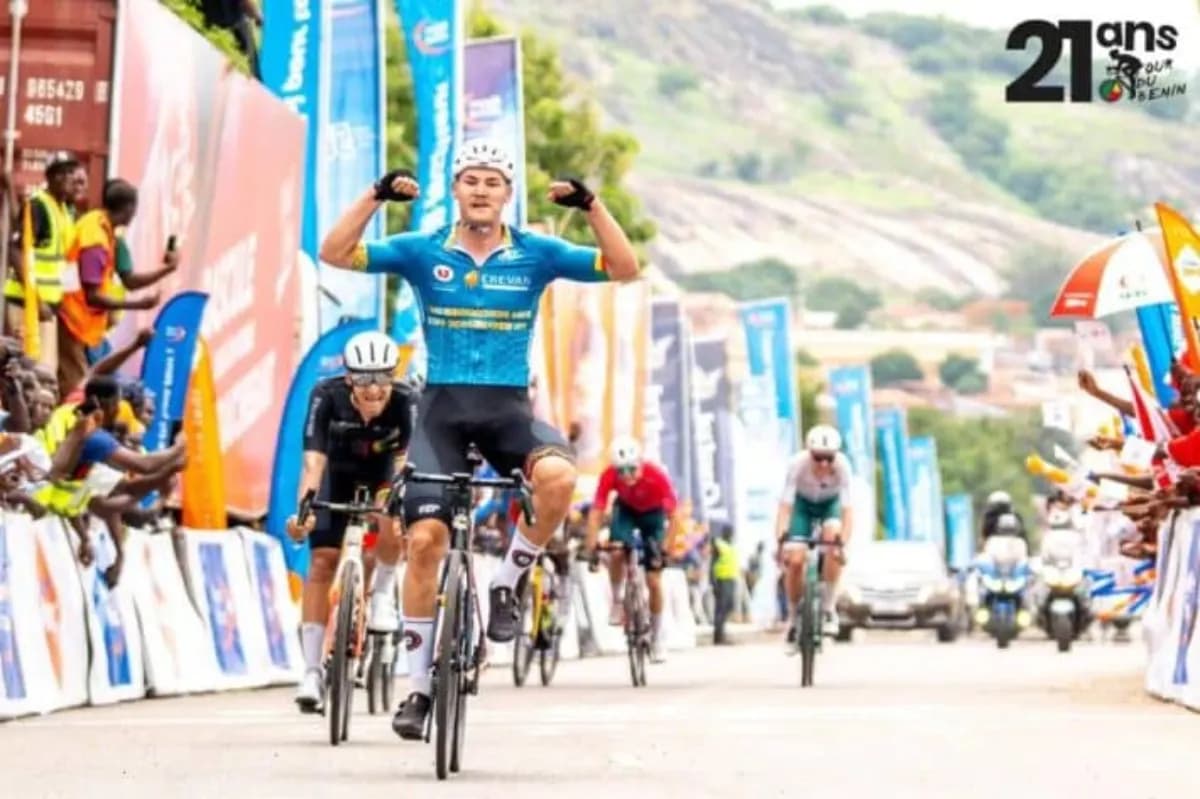
The Benin Tour 2026 offered a revised route of approximately 731.82 km, described by the organizers as one of the most spectacular and demanding in the event’s history. From Zagnanado to Cotonou, via Savè, Djougou, Bantè, Ouinhi and Porto-Novo, the peloton had to contend with heat, wind and punishing profiles, conducive to breakaways and long-range attacks. The race drew a ‘XXL’ lineup with Algerian, Moroccan, Burkinabé and Eritrean selections, West African teams, and the German continental squad Bike Aid, where Belohvosciks competes. This density led to very fast stages, with averages over 41 km/h on certain stretches, underscoring the Benin rendezvous’s rising caliber.
From the first stage Zagnanando–Savè (about 126 km), Kristians Belohvosciks set the tone by winning ahead of a very structured field and donning the yellow jersey. The Latvian, a well-rounded rider accustomed to African races, then managed the central stages perfectly, protected by an experienced Bike Aid collective, amid repeated attacks from the Algerian, Burkinabé and Eritrean selections.
Stage wins were mainly shared between Algeria and Morocco. Mohamed‑Nadjib Assal opened with a double on the 2nd and 3rd stages, confirming Algeria’s potential on the UCI Africa Tour, while Moroccan Salah Eddine Mraouni won the 4th stage Ouinhi–Porto-Novo (127.80 km). On this penultimate day, Mraouni covered the distance in 2 h 54 min 25 s, at an average of about 41.96 km/h, within a quartet contesting the sprint victory.
The final stage Zogbodomey–Cotonou (128.65 km) confirmed the scenario of a very open but controlled race at the summit. Belohvosciks, clocked in 3 h 10 min 34 s at an average of 40.51 km/h, resisted late attacks and held onto his yellow jersey to the finish line, sealing his overall victory.
The Beninese: fewer spectators
Although the yellow jersey remained foreign, the main satisfaction for the host country lies in the behavior of its riders. While the Beninese previously lagged behind by more than an hour on most stages, some of them now finish within less than three minutes of the winner, particularly on the flatter days.
Beninese riders were noted in long breakaways, sometimes more than 100 km at the front, notably on the 5th stage toward Cotonou, a symbol of a shift in attitude. “The locals no longer automatically accept the role of mere followers,” enthuse some supporters. Several young national riders also stood out in the “hot spots,” these intermediate sprints that pace the stages, earning points and confidence for upcoming competitions.
The last in the general classification, the Beninese Thetis Gnanhoui, finished 65th with a gap of about 1 hour 31 minutes behind Belohvosciks, a sizeable gap but one that reflects a race run at a pace set by professional teams and major African selections. This gap should be read less as a sign of individual weakness than as illustrating the remaining collective margin to cross between a cycling scene still in the process of structuring and teams seasoned in multi-stage races.
At the end of the competition, national coach Ferdinand Gandaho hailed “encouraging results” for riders who are still learning the demands of such a dense international field. The technician particularly noted his riders’ ability to stay grouped in the main peloton longer than before, and to better manage heat, nutrition and recovery between two stages.
Romuald Hazoumè, president of the Benin Cycling Federation, stressed, on the other hand, the structural “advances” that are beginning to bear fruit: training camps, increasing national competitions, partnerships with foreign teams, and highlighting young talents through the Tour of Benin. For the FBC, this 21st edition proves that the strategy of training and densifying the local calendar is bearing its first fruits, even if the gap that separates the Beninese from a stage victory or a final podium remains significant.
A date with the future
With a longer route, a reinforced international field, and rising average speeds, the 2026 Benin Tour crosses a sporting and media milestone. For foreign teams like Bike Aid or North African selections, the event becomes a strategic rendezvous to accumulate UCI points, test riders, and showcase themselves on the rapidly expanding African cycling market.
For Benin, the race is gradually turning into a true laboratory of performance: a training ground for locals, a showcase for the country, and a meeting point between organizers, sponsors and foreign federations. The objective stated by the actors of Benin cycling is now to capitalize on this dynamic to, in the medium term, see a local rider play leading roles, first in stage wins, then perhaps in the battle for the yellow jersey.



Comments
Comments load when you reach this section.