
The serious communication mistakes of Tidjame Thiam, President of the PDCI-RDA
Outstanding manager, brilliant administrator, African pride in the world, first in his class wherever he went, the President of the oldest party in Ivory Coast, the PDCI-RDA, granted an interview a few days ago to journalist Alain Foka. It is a treasure trove of information, revealing itself under the magnifying glass of the analysis of political communication codes, a minefield that blows up the square political image he has built over several years.
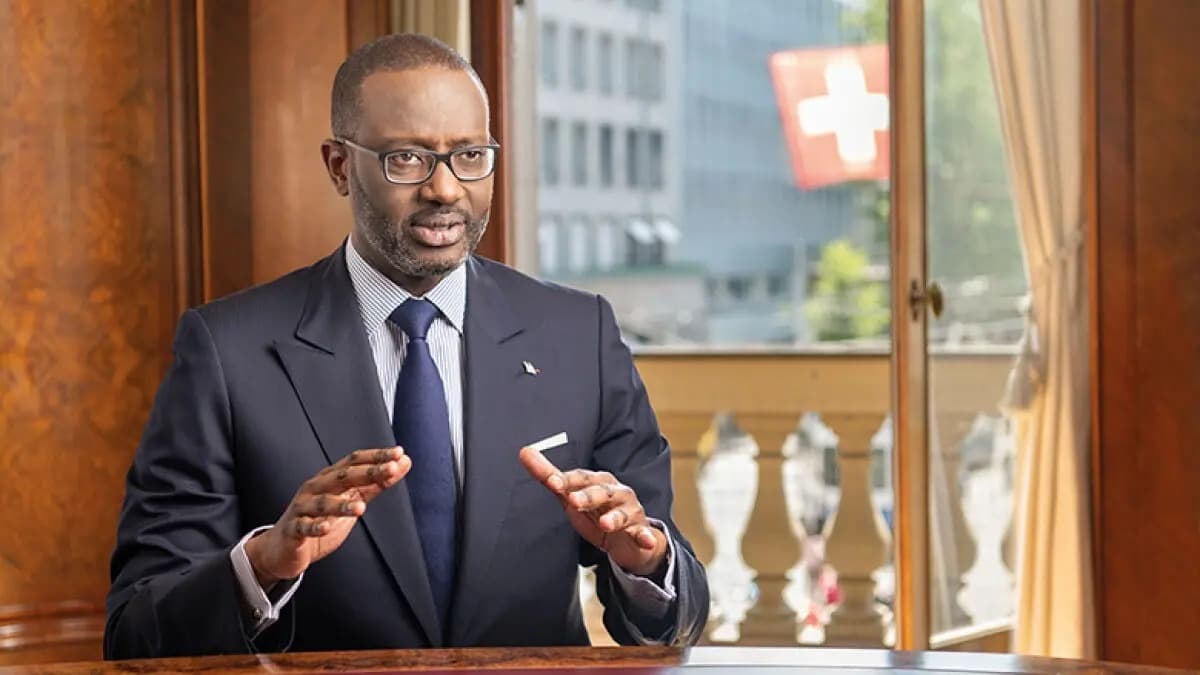
Outstanding manager, brilliant administrator, African pride in the world, first in his class wherever he went, the President of the oldest party in Ivory Coast, the PDCI-RDA, granted an interview a few days ago to journalist Alain Foka. It is a treasure trove of information, revealing itself under the magnifying glass of the analysis of political communication codes, a minefield that blows up the square political image he has built over several years.
The analysis we will attempt to pose here is solely technical. This is important because in our society, it is too common for lazy and obsequious minds to label as heresy, as a lese-majesty crime, the fact that you give your opinion about someone they consider having an extraordinary career. I want to put them completely at ease; here we give a technical opinion, therefore impartial.
That said, let’s return to what I consider a disaster in terms of political communication. It is of the same order, if not worse than President Boni Yayi’s memorable media outing on August 31, 2012, when we heard: “they are small,” “I will bounce,” “I will bring my people from deep Benin and they will confront each other,” “if I cannot find them work, at least I will give them balls so they leave me in peace.” At least Boni Yayi was already in office. That does not make the comments less serious, but I mean that he had at least managed to get himself elected, for a second time. Mr Thiam is far from achieving this ambition, and this misstep distances him further from it.
A media appearance with catastrophic political gains
Mr Thiam, who until now portrayed the image of a very intelligent and polished person, wanted to show his pugnacious side. But he shoots himself in the foot. This is what is called a political suicide properly done. Four major mistakes emerge from this interview. But before addressing them, I question the role his image consultants played in this debacle. Because a man who has come into contact with the world’s greatest fortunes and leaders, when he decides to enter politics, the least we expect of him is to surround himself with highly competent men and women to tailor the suit of a presidential candidate. Unless it was a political trick attempted in despair that went awry.
The first mistake in this political speech is to tell Ivorians that he was not aware of the existence of article 48 of the Ivorian constitution which disqualifies him from the presidential race and that no one in the PDCI-RDA, the oldest party in Ivory Coast, the party of his grandfather, Félix Houphouet under whom this constitution was adopted, knew about it. By making such declarations, he undermines his own image of a brilliant guy he has sold so far and validates the Ivorian justice’s decision to exclude him from the electoral list. His disqualification is then no longer perceived as a political ploy, but as ignorance of the Republic’s texts. I would prefer him to maintain his young lawyer, Rodrigues Adjé’s line of defense who argued that under no circumstances could Tidjame Thiam lose his Ivorian nationality as he did not acquire French nationality later, but was rather born French through his father.
The second major mistake of Mr Thiam during this media appearance is to leave the Ivorian public opinion thinking that he is a coward, a fugitive. A general who fears being arrested and hides in lush lounges in Paris while his troops are being roughed up in the streets of Abidjan. Wanting to conquer power in Ivory Coast from France is an image that completes the demolition of his political man’s shell in the eyes of the public, capable of leading significant battles to carry the aspirations of his party’s militants, of the Ivorian people. It’s like telling Ivorians: “I’m too good and too nice for you. If you really want me to become your president, then fight to create the conditions for me. Meanwhile, I’m staying away from all this”. In politics, perception is everything. And the one that Mr Thiam conveys reassures no one. He fears for his freedom where people lay their lives on the line.
The third image that he conveyed about him during this interview, and which is disastrous, is that of an impulsive gentleman who does not control his emotions, capable of publicly calling people stupid. However, the first mark of a true leader is not his intellectual baggage but rather his ability to lead men, handle crises, be a shield for his people. That’s where we feel the man is desperate. He knows that nothing is possible anymore for him in 2025 and he is up against a wall. For the first time in his life, he holds no cards.
The last mistake, the most serious in my opinion, is the revelation he makes about his exchange with President Ouattara in 2022 where he asked the latter if he would be a candidate again, that if he were, it would be difficult if not impossible for him to be a candidate, and the latter assured him that it was not in his plans. What a disaster! Making such statements, especially in the Ivorian context, is shooting oneself in the head. While all of your supporters and the Ivorian people talk about an unconstitutional term, illegitimate, and want to get rid of President Ouattara, you are revealing that you would not be a candidate if he ran again. Much like a child who has always been given everything and does not know that to conquer power, you have to fight for it. Now that President Ouattara is paving the way for a 4th term, he has no more reason to fight.
This interview is proof that one can be brilliant and do completely stupid things. Political communicators have a textbook case of political communication errors for practical exercises. We’ll finish with this quote from Groucho Marx: “Politics is the art of looking for trouble, finding it everywhere, diagnosing it incorrectly and applying the wrong remedies.”
Related Articles
 Growing insecurity at West African borders and the need for a regional wake-up call.
 Is Mali moving toward a memory law? The urgency of criminalizing colonial and post-colonial crimes.
 Niger seeks justice over Orano’s environmental crimes
 AU-EU Summit: when the question of reparations for historical crimes is forgotten