
Senegal: Diomaye Faye attempted to block Ousmane Sonko’s return to Parliament.
In Senegal, President Diomaye Faye tried to block the return of Ousmane Sonko to Parliament by referring the matter to the Constitutional Council before the plenary session of May 26. However, the court declared itself incompetent, paving the way for the reintegration of the former Prime Minister as a deputy and then his election as President of the National Assembly.

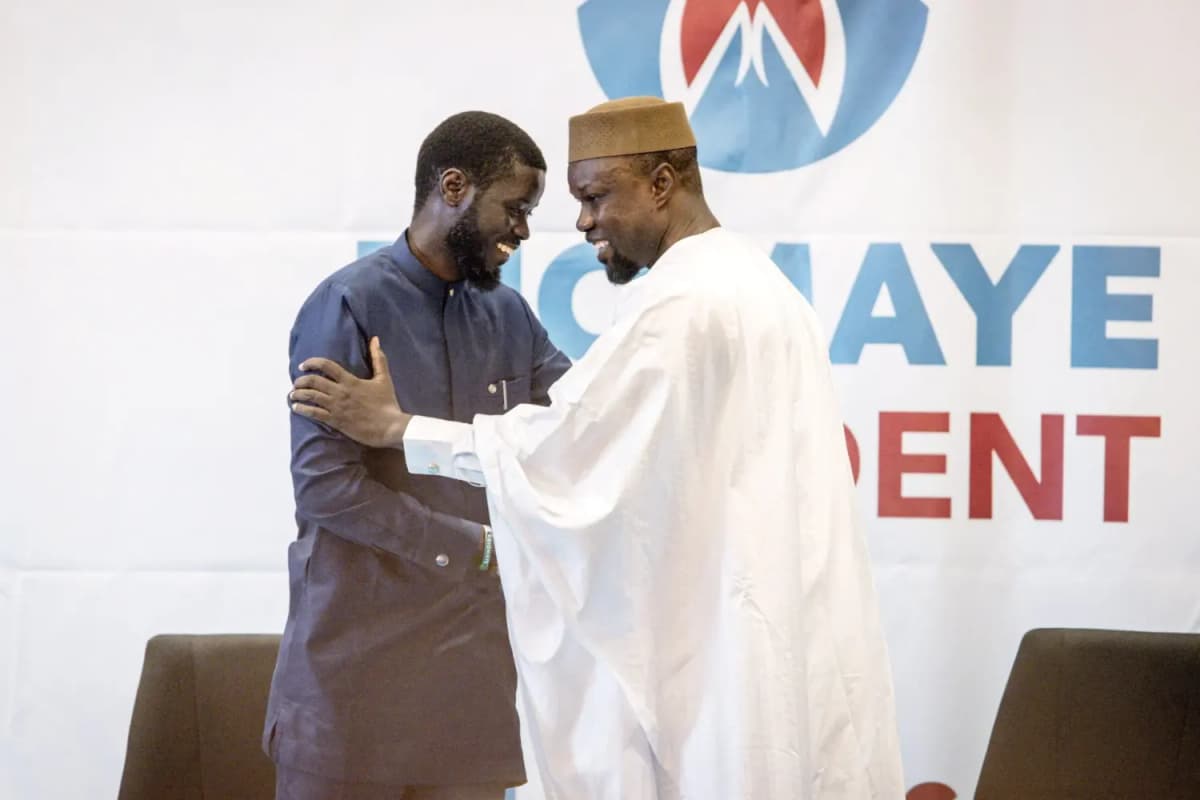
The Senegalese Constitutional Council declared itself incompetent to rule on the question of Ousmane Sonko’s reintegration into the National Assembly, despite the discreet referral by President Bassirou Diomaye Faye that took place on the night before the plenary session on May 26. In its decision, the institution maintained that this matter fell within the internal workings of Parliament and its internal regulations, thereby dismissing any judicial intervention in the case.
The information about the referral was revealed by the Dakar daily Les Échos before the session opened. According to sources reported by Senego and Ndarinfo, the head of state had sought the “seven sages” to obtain advice on the legality under Senegalese law of the procedure proposed by the Pastef deputies. The Constitution, particularly its article 92, reserves the prerogative to refer such institutional functioning questions to the Constitutional Council solely to the President of the Republic. Neither the opposition parliamentarians nor the Supreme Court could directly challenge the acts of the Bureau of the Assembly, which constitutes an internal decision not comparable to the voting of a law.
The plenary was held without waiting for the outcome of the referral. Sonko was reintegrated as a deputy and subsequently elected President of the National Assembly with 132 votes out of 133 voters within a few hours, as the opposition boycotted the vote. The Constitutional Council’s decision to declare itself incompetent thus occurred in a context where the contested institutional acts had already been carried out.
The Legal Foundations of the Disagreement
The controversy revolved around two opposing interpretations of the Constitution and the internal regulations of the Assembly. The opposition, notably represented by the Takku Wallu Sénégal group and several independent legal experts, cited article 54 of the Constitution, which states that “the quality of member of the Government is incompatible with the parliamentary mandate.” The president of the Takku Wallu group, Aïssata Tall Sall, meticulously developed an argument based on this text on Monday, recalling that Ousmane Sonko had led the national list of Pastef in the November 2024 legislative elections while serving as Prime Minister, and that he had stated on television his intention to “maintain his functions as Prime Minister” alongside Faye, which she presented as a definitive choice of the executive mandate over the parliamentary mandate.
Article 123 of the internal regulations further imposes an eight-day deadline on any elected official in this situation to choose between their government functions and their seat as a deputy. Judge Dème, consulted before the session, had argued that the reintegration was “legally impossible.” Legal experts Cheikhou Oumar Sy and Théodore Chérif Monteil had published a statement in the same vein, distinguishing Sonko’s situation, as a citizen elected as a deputy while already holding executive power, from that of a deputy appointed as minister, the only case where article 56 of the Constitution expressly allows for the return to the seat at the end of government functions.
On the other side, constitutionalist Moussa Diaw argued that reintegration was possible, and Pastef relied on article 56 as well as the precedent stating that Sonko’s mandate had been “suspended” and not abandoned upon his appointment to the Primature, with his deputy Ismaïla Wone having never permanently exercised his prerogatives.
The Plenary Session Took Place Before Any Decision
The fact that the plenary session opened at 9:23 a.m. without the Constitutional Council having rendered its opinion is the central element of the sequence. Pastef and the Bureau of the Assembly did not wait for the outcome of the procedure initiated by the presidency. The Council’s declaration of incompetence, made during the day, therefore had no practical effect on the acts already voted by the assembly.
This configuration, a presidential referral that does not yield a binding opinion, faced with a parliamentary majority that proceeds without waiting, illustrates the limits of the recourses available to Faye in the institutional reshuffling resulting from May 26. The Constitutional Council cannot automatically annul the internal decisions of the Bureau of the Assembly. Therefore, the question of the formal validity of Sonko’s reintegration and his election to the presidency remains without definitive resolution by a court, Sonko having held the presidency of the National Assembly as of that May 26 based on the principle of completed acts.
Comments
Comments load when you reach this section.