
Northern bypass of Cotonou: from flagship project to prolonged limbo
Once announced as a symbol of President Patrice Talon’s “rupture” agenda, the northern bypass project in Cotonou now stands as a stark illustration of the challenges tied to ambitious infrastructure ventures in Benin. Amid bold political promises, shifting routes, technical delays, and financial uncertainties, not a single meter of asphalt has been laid to date. A look back at a high-profile project with a winding trajectory.
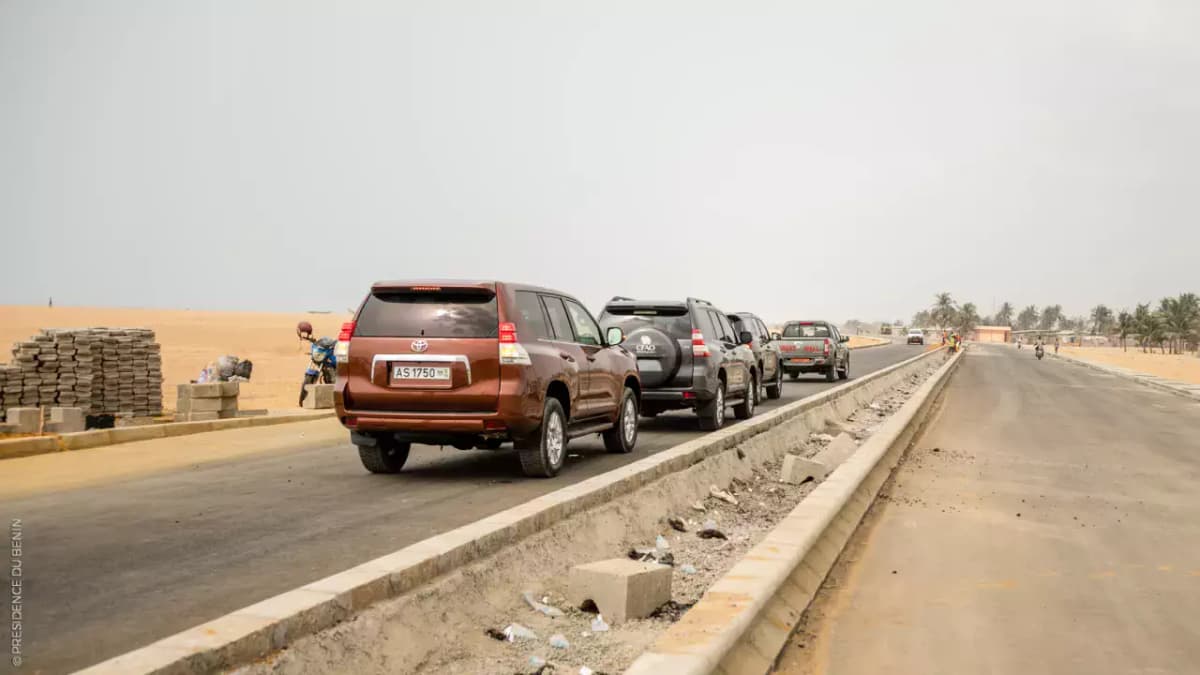
Once announced as a symbol of President Patrice Talon’s “rupture” agenda, the northern bypass project in Cotonou now stands as a stark illustration of the challenges tied to ambitious infrastructure ventures in Benin. Amid bold political promises, shifting routes, technical delays, and financial uncertainties, not a single meter of asphalt has been laid to date. A look back at a high-profile project with a winding trajectory.
Initially conceived to address Cotonou’s chronic traffic congestion, the bypass was intended to divert heavy truck traffic away from the city center by linking key economic corridors—particularly the Port of Cotonou—with the national highway system. On paper, the plan was both strategic and visionary. Touted by the government and heavily promoted in the media, the project was expected to ease urban congestion, boost regional trade, enhance Benin’s logistics competitiveness, and reduce pressure on the city’s overburdened road network.
Included in the Government Action Plan (PAG 2016–2021), the project was initially envisioned as a nearly 40-kilometer highway with a 5.7-kilometer connector to the port, at an estimated cost of 487 billion CFA francs. Three major international groups—Bouygues/Colas, Vinci Highways, and China State Construction—were prequalified in February 2018. The project was to be financed through a public-private partnership (PPP), minimizing public spending while leveraging global expertise.
But despite an ambitious timeline, the project quickly became bogged down. From 2018 to 2022, there was no tangible progress on the ground. Technical studies were repeatedly restarted, financing remained murky, and other projects under the PAG took precedence. The original route—planned to cross the eastern lagoon toward Kpota—was scrapped due to high social costs, including displacement and expropriation. A new path, hugging the western shore of the lagoon, was selected instead.
In March 2024, the project was officially relaunched during a Council of Ministers session. The revised route extended north to Akassato (in Abomey-Calavi), redirecting the bypass west of the urban center. Minister of Living Environment José Didier Tonato stated that the goal was to better integrate economic hubs and reduce land-use tensions.
Strategic delay or political retreat?
This shift wasn’t just technical—it reflected a change in approach. Where urgency once prevailed, the Talon administration has embraced caution, even at the cost of delays. Several factors explain the slowdown:
- The original route required expensive and contentious compensations due to land issues.
- Budget constraints, especially post-Covid and amid global inflation, prompted a financial rethinking.
- A lack of firm commitments from original or potential investors—such as Qatar, cited in 2024 as a possible backer—made early implementation risky.
Some observers also point to overly centralized project management, with progress dependent on presidential approval, limiting the autonomy of technical ministries.
In May 2025, Minister Tonato reiterated that the project is “still on track.” He indicated that technical studies are being finalized and that calls for tenders will be launched in the coming months. Yet, this familiar reassurance rings hollow after six years with no visible construction.
As of today—less than a year before the end of Talon’s second and final term—no concessionaire has been selected and no construction contract has been awarded. The only tangible progress is a revised route and the promise of work beginning between 2025 and 2026, essentially at the tail end of Talon’s presidency. This raises a pressing question: can such a large-scale project realistically break ground—and even begin to take shape—within such a short time frame? Or is this yet another case of politically convenient window dressing?
Key milestones
- February 2018: Prequalification phase launched. Three international consortia were invited to submit bids within three months, with the project framed as a PPP aligned with national infrastructure goals.
- 2019–2022: Preparation phase. According to the Ministry of Transport and budget reports, preliminary studies continued. The project appeared in road infrastructure plans, such as the 2022 budget, but no major construction started. Rumors of abandonment emerged. Behind the scenes, the government was still exploring financing options. In early 2024, Qatari investors expressed interest in several flagship PAG2 projects, including the bypass.
- March 2024: Project relaunch and redesign. On March 13, the government announced a revised project plan. The connector road was shifted to the western side of the lagoon, and the main bypass was extended to Akassato. A consulting firm was tasked with delivering a detailed technical plan, dividing the project into three phases and preparing tender documents. The full bypass, now approximately 37 km excluding the connector, is slated for completion by 2026.
- April–May 2024: The 2021–2026 Government Action Plan reaffirmed the project as a priority, maintaining the 40 km target. Technical studies continued.
- May 2025: Final studies and tender process pending. In a recent update, Minister Tonato confirmed that the project remains active. He noted that final technical documentation is underway, with tenders expected soon. The Kpota junction, though no longer on the main route, will be connected via a feeder road.
Related Articles
 GDIZ: Social housing and solar energy on the agenda for talks with the Saudi Development Fund
 Benin: Admitted to casting more than 42 fraudulent votes, a citizen jailedBenin: a woman with a “fake pregnancy” arrested at the Sèmè-Kraké border