
Morocco: the blocked horizon of Moroccan youth
At the end of July, thousands of young people reportedly attempted to swim to the Spanish enclave of Ceuta from northern Morocco, according to Le Monde Afrique. Behind this migration episode, the testimonies gathered highlight the disparity between the macroeconomic performance of the kingdom and the difficulties in accessing employment, housing, and social mobility.

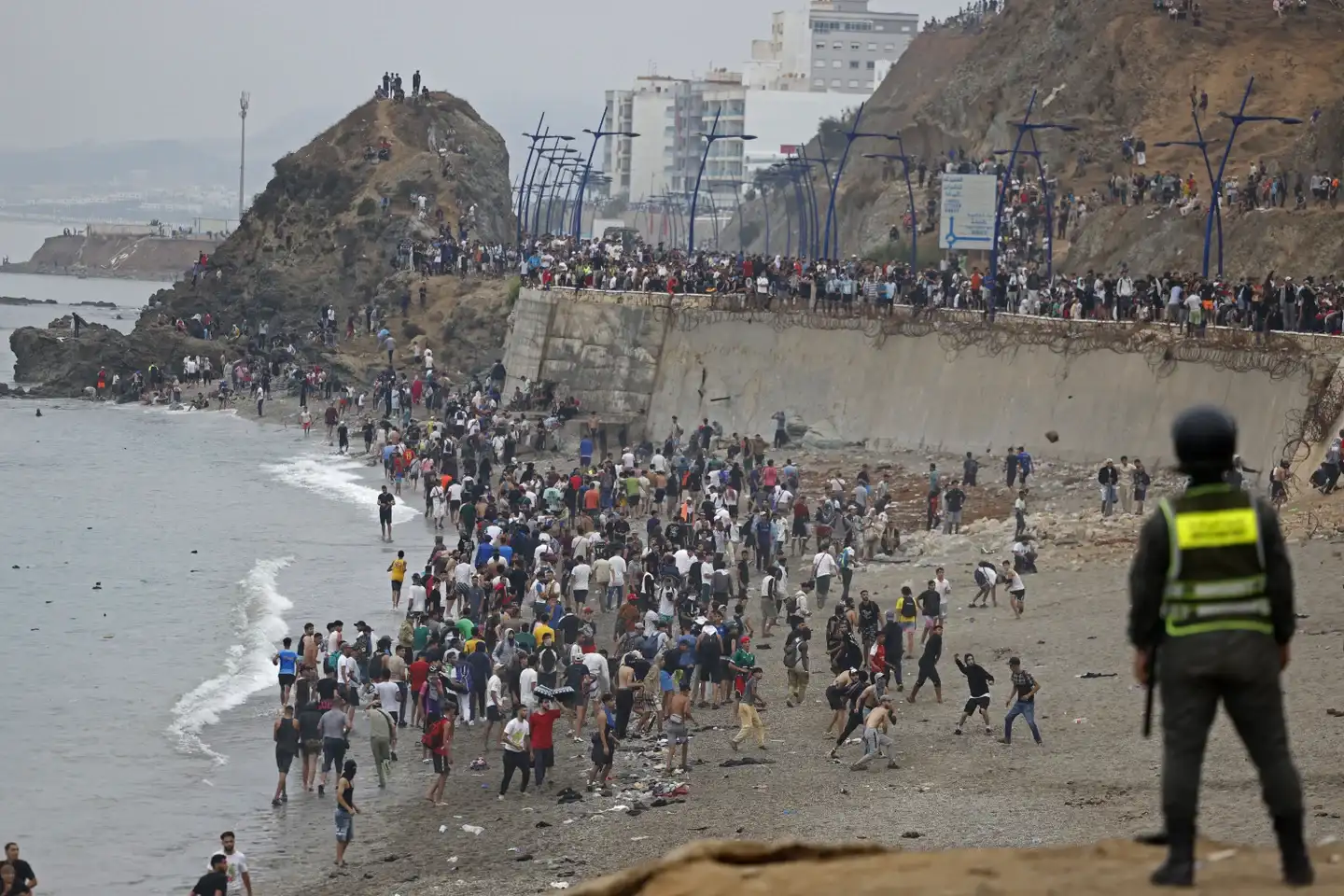
In Fnideq, a Moroccan town facing Ceuta, the candidates for departure are not just unskilled individuals. Some work, have studied, or started families, yet cannot establish financial independence. For them, the Spanish enclave represents less of a specific destination and more of an escape from a situation perceived as hopeless.
Le Monde Afrique reports the story of Othman, 27, who holds a master’s degree in economics and finance. After his studies, he worked in a call center in Casablanca for a monthly salary of 4,000 dirhams. Once he paid his rent, he had practically no resources left to live on.
The young man then returned to his parents’ home in Fnideq, where he found a job as a waiter paying 3,500 dirhams per month. Despite mastering three languages, he remains dependent on his family and does not see himself being able to start his own household. When he saw young people heading to the Ceuta border, he quit his job to join them, according to the account published by the French daily.
According to a World Bank report cited by Le Monde Afrique, over 43% of Moroccan university graduates aged 25 to 34 hold jobs below their qualification level. This phenomenon of declassification fuels a feeling of a lack of prospects, even among young people who have pursued long studies.
Sustained growth, but unevenly distributed
The contrast is even more visible as Morocco’s economic indicators remain strong. According to Jeune Afrique, growth is projected to reach 4.9% in 2025, while investments have risen by 16.3% and foreign direct investment by 74.3%. Tourism has also recorded a high, with nearly 20 million visitors.
The same report indicates that inflation has been reduced to 0.8% and a budget deficit equivalent to 3.5% of the gross domestic product. The industry continues to develop and upgrade, particularly in export-oriented sectors.
However, these performances do not automatically translate into improved living conditions for the entire population. Jeune Afrique highlights the weakness of job creation, the difficulties faced by small and medium-sized enterprises, as well as the still limited connection between foreign investments and the local economic fabric.
Spatial disparities remain significant. Regions far from the main industrial and tourist hubs benefit less directly from the national dynamics. In this context, youth unemployment is said to reach 37.2%, according to figures cited by the Pan-African magazine.
The GenZ212 movement, which emerged in the fall of 2025 around demands focusing on employment, health, and education, had already illustrated this frustration. The mobilizations highlighted the expectations of a generation that considers the redistribution of the benefits of growth to be insufficient.
The debate on Ceuta and Melilla
In the Moroccan press, the analysis of the Fnideq episode also emphasizes the geopolitical dimension. The website Le360 presents Ceuta and Melilla as Spanish enclaves located on territory claimed by Morocco, and suggests that their status maintains a persistent security tension in the region.
The media further claims that individuals attempting to cross the border were not predominantly Moroccan. According to sources it cites, 60% are said to be of Algerian nationality, 35% Moroccan, and 5% from sub-Saharan Africa. This distribution has not been confirmed by other available elements.
Beyond the migration issue and territorial dispute, several Moroccan media acknowledge that the response must also address economic and social conditions. In an editorial, Hespress calls for making youth one of the main beneficiaries of the country’s transformation, prioritizing employment, education quality, vocational training, entrepreneurship, and social mobility.
The media also stresses the need to reduce territorial inequalities. However, the timeline and specific measures likely to meet these expectations have not been detailed in the available content.



Comments
Comments load when you reach this section.