
In Senegal, what remains of the campaign slogan “Sonko, it’s Diomaye”?
Two years after bringing Bassirou Diomaye Faye to power, the phrase “Sonko is Diomaye” now belongs to the past. The dismissal of Ousmane Sonko from the Prime Minister’s office on May 22, 2026, marked the break between the two former struggle companions and opened a new political chapter in Senegal.

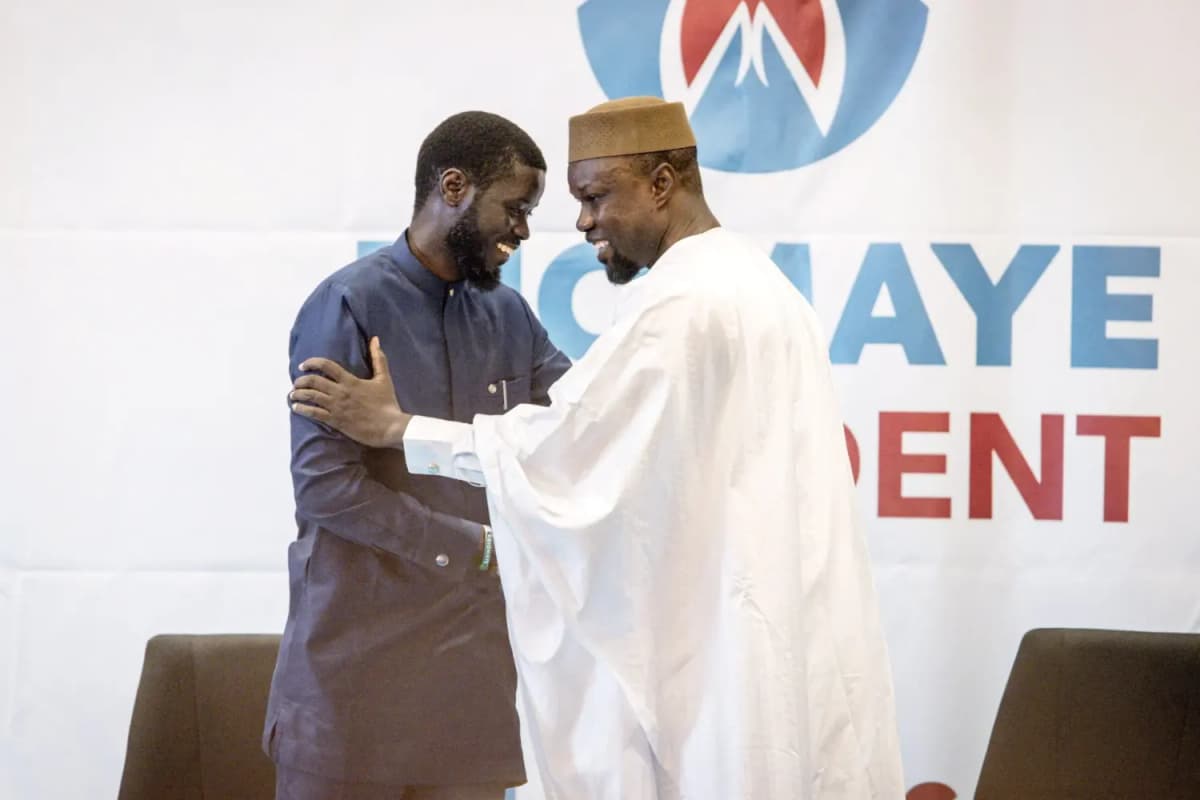
The night of March 14, 2024, will be etched in the memories of African politics. Two men exit the Cap Manuel prison to the cheers of an exuberant crowd. The slogan resonates throughout the streets of Dakar: “Diomaye mooy Sonko, Sonko mooy Diomaye” – Diomaye is Sonko, Sonko is Diomaye. This phrase, chanted in Wolof, was not just a campaign catchphrase. It was the rallying cry of a generation that risked its freedom to force a political change that the former Macky Sall regime sought to obstruct.
After Ousmane Sonko’s candidacy was invalidated by the Constitutional Council in January 2024, he appointed his most loyal companion, Bassirou Diomaye Faye, who was also incarcerated at the time, as the candidate for PASTEF. In less than fifteen days of campaigning after their release, the duo achieved the remarkable feat: Faye was elected in the first round with 54.28% of the votes, triggering the third political alternation in Senegal. The slogan convinced a majority of Senegalese that the two men were one and the same.
Two years later, this equation is shattered. On May 22, 2026, by presidential decree number 2026-1128, Bassirou Diomaye Faye officially ended Ousmane Sonko’s functions as Prime Minister, leading to the dissolution of the entire government. The campaign slogan is now seen as “outdated,” and too bad for those who still believe in electoral promises.
An alliance marked by an inherent contradiction
The relationship between Bassirou Diomaye Faye and Ousmane Sonko was built on a longstanding closeness. The two men met at the National School of Administration before embarking on a similar career as tax inspectors. They then participated in the creation of PASTEF in 2014, around a discourse of breaking away from the old Senegalese political system.
However, this closeness also bore a contradiction. Ousmane Sonko was the party leader, the popular orator, and the main figure of the opposition. Bassirou Diomaye Faye had long remained in his shadow before being designated candidate for the 2024 presidential election. His election to the highest office placed both men in a delicate institutional situation: the political leader of the camp was not the president, while the president had to exercise the constitutional authority of the state.
Ousmane Sonko’s appointment as Prime Minister, following Bassirou Diomaye Faye’s inauguration, initially seemed to preserve the duo’s balance. But, in reality, the coexistence between the institutional legitimacy of the president and the political legitimacy of the PASTEF chief gradually morphed into rivalry.
This tension was all the stronger as PASTEF largely controlled the National Assembly after the November 2024 legislative elections, with 130 out of 165 seats. Ousmane Sonko thus retained a significant political base, while Bassirou Diomaye Faye slowly sought to assert his presidential autonomy.
Fissures made public
The first visible signs of the break appeared in November 2025. Bassirou Diomaye Faye then decided to dismiss Aïssatou Mbodj, close to Ousmane Sonko, from the head of the coalition “Diomaye Président”, replacing her with Aminata Touré, his own campaign coordinator. This decision contradicted a public stance by Sonko, who had assured that no changes were planned at the head of the coalition. PASTEF responded with a statement rejecting the presidential decision. For the first time since the duo came to power, the disagreement between the head of state and the majority party was laid out publicly.
The divergences were not merely organizational. They also concerned substantive issues, including debt, relations with the International Monetary Fund, and how to treat officials of the former regime. Ousmane Sonko defended a more aggressive line, characterized by breaking with the past and accountability. Bassirou Diomaye Faye preferred a more conciliatory and institutional approach.
In March 2026, the crisis reached a new level. During a live intervention on his social media, Ousmane Sonko warned that PASTEF was prepared to leave the government and join the opposition if the president strayed from the common political line. A few days later, Bassirou Diomaye Faye officially declared the political autonomy of the coalition “Diomaye Président” by holding a general assembly without PASTEF.
The break became clearer in April 2026 when the National Assembly, dominated by PASTEF, urgently adopted electoral code amendments allowing Ousmane Sonko to run for the 2029 presidential election. The vote, passed with 128 votes, rekindled tensions surrounding succession. Bassirou Diomaye Faye then denounced an excessive personalization around his Prime Minister.
On May 2, 2026, the president publicly acknowledged the existence of disagreements with Ousmane Sonko, while asserting that the two men had until then managed them responsibly. Less than three weeks later, the decree terminating the Prime Minister’s functions closed this chapter.
2029 looming on the horizon
Behind the institutional crisis, the question of the 2029 presidential election weighs heavily. In 2024, Ousmane Sonko, prevented from running, had appointed Bassirou Diomaye Faye as the PASTEF candidate. Some of his supporters implicitly believed that Faye should carry the project until Sonko could return to the presidential race.
However, the exercise of power changed the balance. Bassirou Diomaye Faye, now president, was no longer willing to appear as a mere temporary holder of power. Meanwhile, Ousmane Sonko remained the central figure of PASTEF and retained strong popularity among the activist base.
The electoral reform of April 2026 crystallized suspicions. For the president’s close allies, Sonko was already preparing for 2029. For supporters of the former Prime Minister, Faye seemed to be seeking to emancipate himself from the party that brought him to power and build his own political apparatus.
This rivalry surrounding the next presidential election is not officially acknowledged as such by either man. Ousmane Sonko even stated in early June 2026 that it was still premature to talk about candidacies. However, in practice, this issue now structures the power dynamics within the camp that emerged from 2024.
A president without PASTEF, a Parliament controlled by Sonko
After his dismissal, Ousmane Sonko did not exit the center of political action. On May 26, 2026, he was elected president of the National Assembly with 132 votes out of 133 cast. He thus became the second personage of the state and maintained a significant institutional position against the head of state.
Bassirou Diomaye Faye appointed Ahmadou Al Aminou Mohamed Lô as Prime Minister on May 25, 2026. The new government, presented on June 1, includes 30 ministers. It stands out for the absence of the main figures of PASTEF, as Ousmane Sonko’s party refused to participate.
Senegal thus enters an unprecedented political configuration: a president from PASTEF now governs without PASTEF, while the party retains a substantial majority in the National Assembly. This situation creates a form of atypical cohabitation, where the head of state has presidential legitimacy but must navigate a parliamentary majority controlled by his former ally.
The president cannot dissolve the National Assembly until December 2026, two years after the last legislative elections. Until then, Ousmane Sonko holds the chair and has substantial influence over the legislative agenda. His re-election on June 6, 2026, at the head of PASTEF with 589 votes out of 598 strengthens his status as the political leader of the party.
In this context, the local elections of 2027 and the possibility of dissolving the Assembly starting in December 2026 already appear as crucial deadlines. They could allow each camp to measure its real weight in the country.
A formula that has become impossible to uphold
The break between Bassirou Diomaye Faye and Ousmane Sonko does not merely signify the end of a governmental tandem. It also marks the collapse of a political narrative. In 2024, “Sonko is Diomaye” had allowed for the transfer of the popularity of the head of PASTEF to his candidate. The slogan had lent coherence to a campaign conducted in a hurry and in a context of intense political tension.
However, once in power, this symbolic fusion could not sustainably withstand institutional realities. The President of the Republic could not remain in the shadow of his party’s leader. The Prime Minister, for his part, could not renounce the political authority built during the years of opposition.
Power thus put the promise of the slogan to the test. Disagreements over debt, the IMF, relations with the former regime, the place of PASTEF activists in the administration, and preparations for 2029 gradually revealed two distinct trajectories.
In his first statements after his ousting, Ousmane Sonko attempted to adopt a conciliatory tone, asserting that Senegal was greater than political disagreements. But his installation at the head of the National Assembly and PASTEF’s refusal to join the new government demonstrate that the separation is now political, institutional, and strategic.
Two years after the historic victory of 2024, the slogan “Sonko is Diomaye” has thus lost its function. It was useful for gaining power. It is no longer sufficient to exercise it. Senegal is now entering a new phase, dominated by rivalry between two former struggle companions, emerging from the same political project but now facing each other at the pinnacle of the state.
Comments
Comments load when you reach this section.