
Israel-Iran war: the deadly spiral
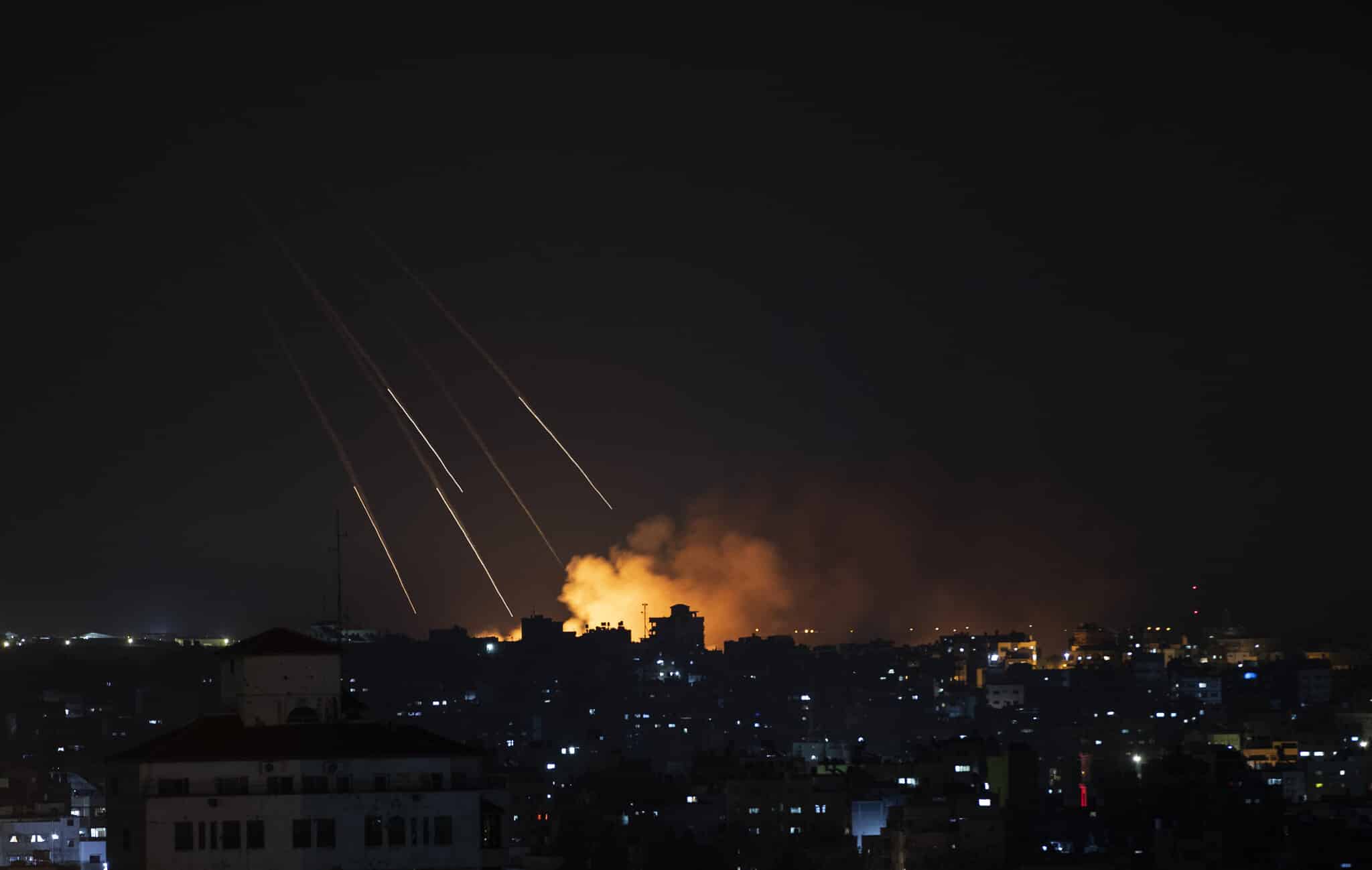
Israel has just crossed a new threshold in its military escalation in the Middle East. After several months of war in Palestine, settlement expansion in the West Bank, bombing in Syria, Yemen and Lebanon, not to mention the drone attack, the Hebrew state has launched a massive offensive against Iran. Netanyahu and his allies now appear determined to drag the entire region into all-out war. On the night of 12 to 13 June, Israel sent nearly 200 warplanes along with drones to pound military and nuclear sites in Iran, as well as residential buildings. A vast offensive that killed 78 people, including children, and wounded 320 others. Among the victims, several senior officials of the Iranian regime, as well as scientists, died in their homes along with their families.

Israel immediately switched on its propaganda machine, once again claiming that striking Iran was simply self-defence. Netanyahu’s government produced an abundance of intelligence supposedly proving that Tehran was nearing the point of no return, and I quote, “toward the atomic bomb”. This, it argued, justified a preventive strike. On 11 June, during a hearing before the Senate, Israel’s ambassador to France recalled his country’s fears about the Mullahs’ regime acquiring the ultimate weapon. The diplomat then stated that “Our goal is to prevent Iran from having a nuclear weapon, whatever it takes.”
Naturally, to hear them tell it, this strategy has only one goal: to bring about peace by any means necessary, including waging war. We know the old refrain — it’s the arsonist crying fire — and what’s most alarming is surely that France is handing him the match. The day after the massive attack on Iran, Foreign Minister Jean-Noël Barrot echoed the Israeli government’s talking points, reaffirming “Israel’s right to defend itself against any attack”. A few hours later, Emmanuel Macron said essentially the same thing. The French president even added that if Israel were to be attacked, France would take part in defence operations — a particularly worrying prospect of becoming embroiled in the conflict.
The support we have always given — but I have always been clear, it is not unconditional, unlimited support. And I was clear, too, when it came to fighting Hamas’s terrorism, which we forcefully condemned on 7 October. We supported all of Israel’s targeted operations, its determination to clearly protect itself from terrorism. But under no circumstances did we support operations that endangered civilian lives. That’s why, from the end of October 2023, we called for a ceasefire in the territory. As for Iran, we support Israel’s security. So if Israel were to be attacked in retaliation by Iran, France, given its commitments and if it were in a position to do so, would take part in operations to protect and defend Israel.
Reactions on the left were swift, with the entire La France Insoumise party expressing outrage at these remarks. MP Aurélie Trouvé, former spokesperson for Attac and now chair of the National Assembly’s Economic Affairs Committee, believes the French government’s response is beneath contempt. Jean-Luc Mélenchon says he fears a terrifying escalation toward all-out war, and Éric Coquerel appeared this morning on Public Sénat. He is calling for the UN Security Council to be convened to demand that the fighting stop. Let’s listen to him.
“Israel is not defending itself. They are attacking. Israel is attacking right now. Honestly, it’s quite extraordinary how things get turned upside down, and how, unfortunately, some of us pick up certain talking points from the Israeli government. The Israeli government says: we are bombing military targets, not that we’re attacking civilians. Well, just look at the death toll on both sides to see that this isn’t credible. Now the Israeli government says they have the right to target — it’s not even about the nuclear programme anymore — they have the right to personally target leaders of the Iranian regime. Now, I have no sympathy for the leaders of the Iranian regime. We have always opposed the Mullahs’ regime. So on that point, we have no issue. But for Israel to grant itself that right, as a genocidal government that, I believe, has nothing to envy in the values currently held by the Mullahs… I don’t see today how it could be defending universal values against a Mullahs’ regime that we condemn. I find all of this staggering, and that it’s taking a considerable risk in the region.”
Unsurprisingly, at the other end of the political spectrum, the discourse is radically different. France’s far right displays unreserved support for the Israeli government’s authoritarian and messianic drift. One need only listen to Éric Zemmour, interviewed on public television.
“For him, 7 October justifies all of Israel’s wars, which supposedly no longer need to worry about international law. It’s war, he repeats, over and over. And so, according to him, Netanyahu supposedly has a free hand to bomb the entire region.
They’ve understood that there would be an eternal war. Personally, I don’t believe in the possibility of peace. I don’t believe you can say there’s an eternal war. What does that mean? That Israel must destroy all its neighbours. It means it has to do what it has done. That is, it destroyed Hamas, it destroyed Hezbollah, in Syria, while protecting the Druze. Yeah. And now it’s attacking the parent company of all these groups, since all these groups were just proxies, as they say, of the parent company, which is Iran. So it’s attacking Iran, if you will. 7 October proved that there would never be peace, and that therefore all the inflammatory statements from Israel’s adversaries had to be taken seriously. And that’s why it’s now bombing the… So for me, this is war.
On CNews, the same refrain. Israel is supposedly the last bastion of the West, waging an alleged civilisational war. A hollow narrative that serves as an alibi for everything, up to the unspeakable. Within this logic, war becomes legitimate, settlement expansion becomes a duty, and the racist ideology of the Israeli far right is recycled as a defence of supposed Western values.
You are absolutely right, and first of all, I would like to express my support for the Israeli people, my respect and my admiration. The Israeli people experienced one of the greatest traumas in its history since the Second World War, on 7 October. And the very next day, this people rose back up with strength. This people has an incredible moral and mental fortitude. And you are absolutely right, Anthony. The Israelis are fighting for their survival, but the Israelis are also defending our values, and also defending the security of the West and the security of Europe. Because the Iranian nuclear threat endangers the whole of the West. Because Iranian missiles could very well one day hit France, because there have already been attacks commissioned by Iran on our soil. And yes, you’re right, Anthony, Israel is doing the dirty work today.
Several international actors have reacted to the recent tensions. The UN, the European Union, NATO, China and the United Kingdom have called for restraint. Germany took a position close to that of France, reaffirming Israel’s right to defend itself. By contrast, countries in the region such as Turkey, Saudi Arabia, Qatar and the United Arab Emirates condemned the Israeli strikes, calling them serious provocations. Iraq, for its part, denounced an act of aggression and accused Israel of violating its airspace. Russia sharply criticised the attacks, deeming them unacceptable and unprovoked. The African Union, meanwhile, warned of a major risk to global peace. And finally, the International Atomic Energy Agency was keen to recall a fundamental rule: nuclear facilities must never be targeted.
The Israeli attack naturally prompted Iran to retaliate with bombing of its own. So missiles have been crossing paths, and the Iron Dome has been put to a severe test. Nearly 250 deaths have been recorded in Israel and Iran since Friday. The Israeli prime minister’s office reports 24 deaths, 11 of them on the night of Sunday into Monday. On the Iranian side, the latest toll speaks of at least 224 deaths and more than a thousand wounded. This Sunday on RTL, the French foreign minister described Iran’s nuclear programme as a threat not only to Israel but also to Europe. Beyond once again echoing Israeli propaganda, he is playing on the West’s moral panic.
Israeli historian and Iran specialist Agai Ram gave an interview to our colleagues at Mediapart, in which he describes this fear of an Iranian nuclear weapon as irrational, manufactured and politically exploited for decades. He explains in particular that Iran has never directly threatened Israel. He points out that Iran is a signatory to the Non-Proliferation Treaty, unlike Israel, which nonetheless possesses a recognised nuclear arsenal. This morning on France Inter, Armelle Harfi, a senior reporter at Le Point, pointed out this inconsistency in the situation. She highlights that Israel, because of its alliance with Western powers, benefits from special treatment that is never called into question.
“The follow-up to this question: does Israel have the right to nuclear weapons and not Iran? That’s the million-dollar question, that’s our listeners’ question. I’ll go further, I’m going to answer, I’ll go even further. Iran — Israel is not a signatory to the Nuclear Non-Proliferation Treaty, just like India and Pakistan, the three countries that have the bomb. Iran is a signatory to the Non-Proliferation Treaty, does not currently have the atomic bomb, and finds itself being bombed. To answer your question, the answer is simple. It comes down to being an ally of the West, and international law, at the time it was established, was established by the West.”
According to experts, Israel’s stated goal of preventing Iran from acquiring nuclear weapons by force is futile. A complete dismantling of the Iranian programme would be unrealistic. Even with a heavy barrage of targeted strikes, missiles cannot destroy the knowledge accumulated by Iranian scientists. It is also difficult to reach every facility, particularly underground sites such as Fordow, a highly secure site out of reach of known Israeli weapons. The United States, which has bunker-busting weapons, would therefore need to get involved. For now, Donald Trump is convinced that a deal between Iran and Israel to end this conflict could easily be reached. However, he has issued a warning to Tehran.
“If we are attacked in any way by Iran, the full strength and might of the American armed forces will come down on you at levels never seen before.”
The American president, an ally of Israel, himself admitted that he had been informed of the Hebrew state’s plans regarding Iran. According to several media outlets, including AFP, the Israeli military informed Washington over the weekend that it had an opportunity to eliminate Iran’s supreme leader, Ayatollah Ali Khamenei. Donald Trump nonetheless opposed this plan. “The Iranians haven’t killed any Americans, and discussion of killing political leaders shouldn’t be happening,” a member of the US administration said. Faced with this American opposition, Benjamin Netanyahu backed down, letting a false story stand instead. Since the start of its offensive, Israel has killed several senior Iranian officials, including the head of the Revolutionary Guards, the army’s chief of staff, and nine scientists from the nuclear programme. Benjamin Netanyahu also announced on Fox News on Sunday that Iran’s intelligence chief and his deputy had been eliminated in a strike on Tehran.
After decades of proxy war and isolated operations, this is the first time the two enemy countries have clashed militarily with such intensity. For some analysts, the offensive launched by Netanyahu against Iran is also aimed at sabotaging the nuclear talks between Tehran and Washington. But this show of force could backfire on Israel. More and more experts fear that, feeling under attack, the Iranian regime will secretly accelerate its race toward the atomic bomb.
Netanyahu relies on the Western consensus around the Iranian nuclear threat to advance his own agenda. This conflict serves him as a political weapon. Beyond the claimed security rationale, the aim is to divert attention from the Palestinian question, to block any prospect of a Palestinian state, and to shore up his personal grip on power at a time when he faces corruption charges. With the conflict he has launched, he is diverting the media attention that had, for some time, been focusing on the situation in Gaza and the war crimes committed by Israel — crimes brought to light in particular by activist and grassroots initiatives seeking to break the humanitarian blockade.
In his book “Iranophobia”, historian Agai Ram argues that this fear of Iran is a projection of Israeli anxieties about the country’s own future, particularly regarding its religious and authoritarian evolution. Israel and the Mullahs’ regime share numerous politico-religious characteristics, notably a strong messianism, the centrality of religion in political life, and authoritarian, charismatic figures. The animosity between the two regimes, he argues, is therefore fuelled as much by their similarities as by their differences.
On 12 June 2025, in Israel, a far-right youth movement held a conference attended by several ministers from the Netanyahu government. The Heritage Minister called for the annexation of the West Bank, Gaza, Syria and Lebanon, as part of the biblical project of Greater Israel. He tied this ambition to a radical religious vision. His openly expansionist and theological speech was met with applause — remarks that echo those he made this past May.
“If the population of Gaza suffers, Hamas will suffer. There’s no problem with bombing their food and fuel reserves. They should starve.”
He had also previously stated that dropping an atomic bomb on Gaza was an option. As the independent outlet Contre-Attaque recalls, at that same conference, other ministers, such as the Communications minister and the Finance minister, also defended the complete annexation of the West Bank and Gaza, thereby fully embracing the project of ethnically cleansing the region.
On 29 May, Israel officially approved the creation of 22 new settlements in the West Bank, an act hailed as “historic” by Defence Minister Israel Katz, in total disregard of international law. Since October 2023, the settler movement, some 500,000 strong in the West Bank, has stepped up its violence. Settlers have also been seizing homes and land and committing abuses such as looting, destruction and, at times, even massacres against the Palestinian people.
Israel’s offensive against Iran is not merely a military episode; it is a tipping point. For the first time, after years of indirect warfare and clandestine operations, two regional powers are confronting each other openly. This escalation, far from accidental, appears calculated. It aims to redraw the lines of power in the Middle East, to push back any international pressure on the Palestinian question, and to sabotage any diplomatic momentum between Iran and the United States. Netanyahu is following a well-known strategy: that of the fait accompli. By ceaselessly invoking self-defence and brandishing the spectre of nuclear weapons, he seeks to secure total impunity for his actions in Gaza, the West Bank, Beirut, Damascus, Tehran and elsewhere. But this security narrative no longer holds up. The facts speak for themselves. Israel is pursuing an expansionist, supremacist, colonial and openly bellicose policy on a regional scale. The question is no longer simply whether Iran will acquire nuclear weapons. Today’s question is: how many more deaths will it take before the international community stops rubber-stamping war crimes under the guise of a strategic alliance? The silence of Western powers is not neutral. It makes them complicit in Netanyahu’s devastating policy.


Comments
Comments load when you reach this section.