
Benin: Facing the youth, Patrice Talon with an open heart but closed ears
With less than a year left in his current term, Beninese President Patrice Talon invited the youth to an unprecedented public exchange at the Republic’s palace. The event, held on July 28, 2025, aimed to be participatory, friendly, and educational. However, behind this apparent openness, several blind spots remain, and some governance choices are hard to defend in light of the expectations expressed.
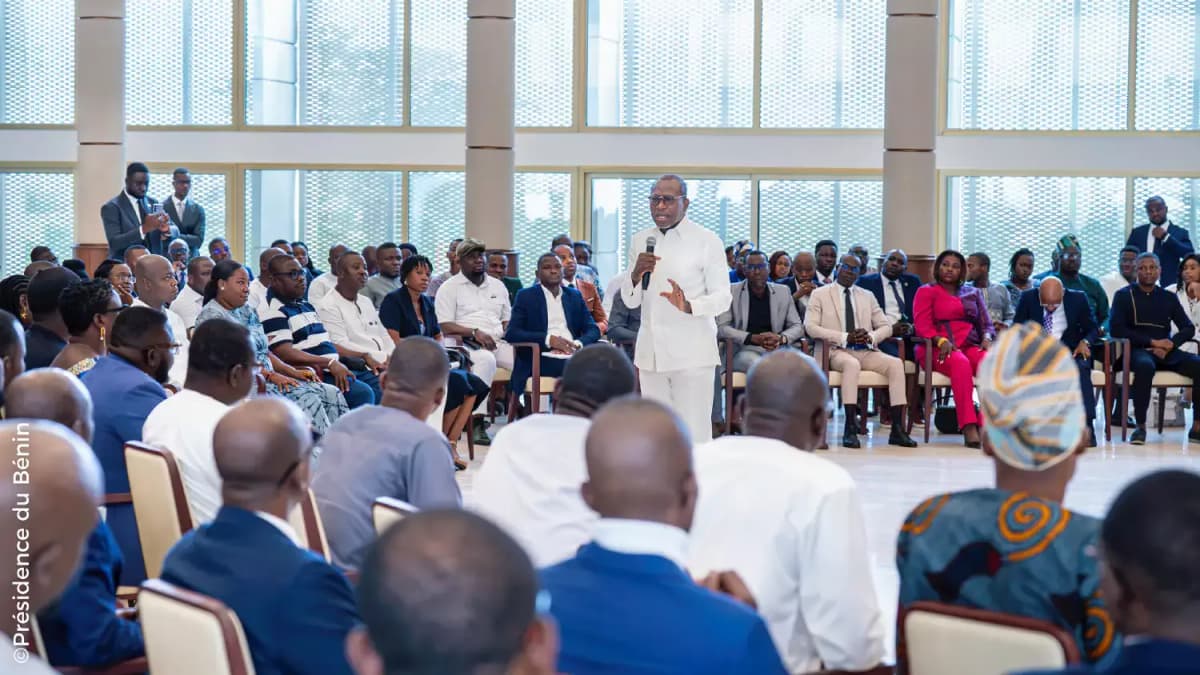
From the get-go, Patrice Talon took control of the format, turning the dialogue exercise into a lengthy monologue. Regularly instructive and often professorial, he outlined his vision of development with the confidence of a captain who knows his trajectory. But in his effort to explain, he also dodged, as this “lecture” posture sometimes overshadowed the initial intention of listening.
A Top-Down Pedagogy, More Than a True Exchange
When asked about job insecurity, the Head of State preferred to defend a policy of labor market deregulation. He suggested that protecting jobs would hurt competitiveness and scare off investors. According to him, the priority should be given to creating massive jobs through private investment, even if it means relaxing some protections for workers. For the president, “it’s better to deregulate jobs to create jobs, than to regulate jobs and create none.” He acknowledged, however, that employee security also depends on the quality of their performance and the competition between employers in a dynamic environment.
A stance that relegates social guarantees to the background, and which obscures a reality. In Benin, growth does not create enough decent jobs, let alone lasting ones.
Instead of acknowledging these warning signs, the president, in most cases, reformulated them to better integrate them into his argumentative logic. At no point does he seriously question the direction of his economic policies. Instead, he justifies them point by point, even trivializing some social sacrifices.
He defends an economy where the quality of the worker should ensure his stability, not the law; where laws must above all secure investors, not balance social relations. A clear ideological stance, but one that overlooks a well-known reality. Namely, that the majority of young graduates do not have access to entrepreneurship and struggle to find their first job, let alone a decent one.
A Belated Admission of Failure on Technical and Vocational Training
The president acknowledged his failure to implement his ambitious plan for technical and vocational training. He even described it as his “biggest frustration.” He regretted that this ambition was not prioritized earlier in his terms, even though, he reassured, “everything is ready now” for the construction of about sixty technical schools throughout the country. A reform he hopes to see deployed in the next 18 to 24 months, aiming by 2035 for 7 out of 10 young people to be trained in a practical trade.
But this admission raises another question. Why wait until the end of two terms to implement such a vital reform? If “everything is ready” today, what were the previous governments doing since 2016? This delay is less inevitability than a political choice, dictated perhaps by other priorities, less visible in the immediate, but more politically profitable.
Candide Azannaï, Boni Yayi, and a Discourse on Sovereignty
In mentioning his former ally Candide Azannaï, Talon attempted a gesture of appeasement. “I suffer from our disagreement,” he said. He claims to hope for reconciliation “the day after” his exit from power. A rare admission in the Beninese political arena, but one that is telling. Because while Talon concedes the pain of a breakup, he never returns to the reasons for this political fracture. His attitude towards Boni Yayi, whose name he does not mention but whose party Les Démocrates was mentioned several times in the exchanges, is similarly ambiguous.
These signals, though emotionally charged, come late. Because the fractures are there. And when a young person asks him to show clemency towards certain prisoners, his response wavers between empathy and refusal to give into what he calls “the systematization of political pardon.” A stance that contradicts calls for easing tensions.
Also, Patrice Talon advocates strong sovereignty. “Independence means paying out of pocket,” he says. But this national pride is hardly compatible with an economic environment where electricity, water, or internet remain expensive. And when he justifies these prices by the need to repay the debt or ensure infrastructure maintenance, he forgets a fundamental truth: that sovereignty is also about ensuring access to basic and affordable services, not merely displaying fiscal discipline.
On several occasions, Talon stressed the need for political parties to work together, even calling to “move beyond the ruling-opposition clichés.” Behind this call for national harmony lurks a more complex reality. The electoral reforms, which he praised, are making access to representation increasingly difficult for independent groups, and the current electoral code seems not to promote diversity but consolidate a politically controlled landscape.
Related Articles
 In Benin, a failed coup d’état — but one that raises many questions
 Daniel Edah: 4 reasons that make him the opposition’s candidate in 2026
 Presidential Election 2025 in Côte d’Ivoire: these candidacies that conceal another political calculation
 Ivory Coast: 3 confessions of failure behind Alassane Ouattara’s candidacy