
World Cup 2026: FIFA bans personal water bottles in stadiums
A week before the kickoff of the 2026 World Cup, FIFA prohibits fans from entering stadiums with their own water bottles, even reusable ones. Presented as a safety measure, this decision is already sparking controversy as the tournament will take place in the middle of the North American summer, in several cities exposed to extreme heat.

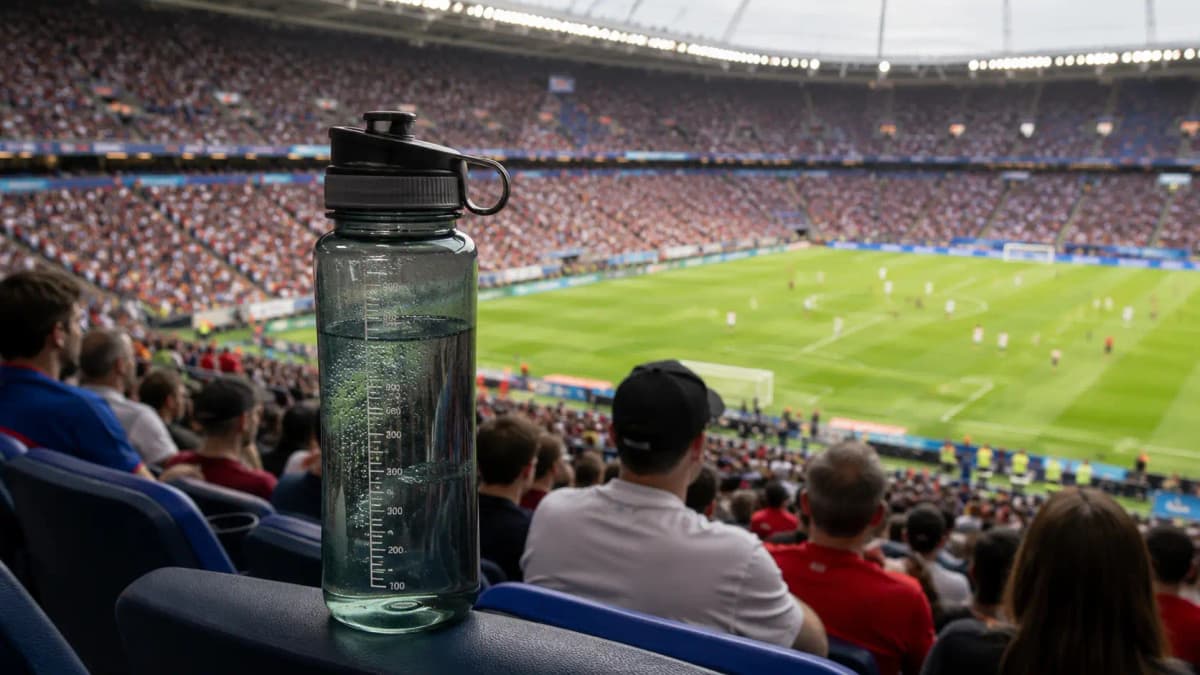
FIFA announced on Wednesday, June 4, the ban on fans bringing their own water bottles into the sixteen stadiums of the 2026 World Cup, which kicks off on June 11 in Kansas City. The measure, initially revealed by The Athletic magazine, is based on safety grounds and requires spectators to purchase their water inside the venues. In a statement to AFP, FIFA indicated that it had “made the decision to ban bottles in order to prevent risks and injuries to players and spectators,” adding that “bottles from outside are already banned in several of these venues for safety reasons” and that it was now applying this rule to all stadiums in the tournament.
The code of conduct in the stadiums established by FIFA specifies in point 3.1.11 that “to avoid any ambiguity, reusable water bottles are not allowed inside the stadium.” This measure represents a tightening compared to previous rules: empty plastic bottles, which could be filled at water fountains, were still allowed until Tuesday. FIFA clarified that the price of water bottles inside the stadiums would remain “in line with that of other events held at each stadium.”
FIFA also stated that it was “working closely with each host city organizing committee and local authorities on heat mitigation measures for fans going to the stadium,” citing misting fans, hydration stations, cooling tents, and other arrangements around the perimeter of the stadiums.
A controversial decision in a context of extreme heat
The measure has sparked controversy due to the climatic context of the tournament. The 2026 World Cup takes place from June 11 to July 19 in the midst of the summer season in the United States, Mexico, and Canada, in cities like Miami, Houston, Dallas, or Los Angeles. Climatologists had estimated in a recent report that “oppressive heat” could affect a quarter of the matches in the tournament, including the final planned at MetLife Stadium in New Jersey. During the last summer’s Club World Cup, many matches were held at temperatures exceeding 32 degrees Celsius, with humidity significantly exacerbating the perceived heat.
While several tournament venues are closed and air-conditioned, the majority are open-air stadiums. The ban on bringing personal water in this context has immediately been perceived by fan associations and public health experts as a measure exposing spectators to risks of dehydration, particularly for the elderly, children, and pregnant women. FIFA has so far maintained its position.
Hydration breaks during the game, but not in the stands
The ban on personal bottles contrasts with new measures implemented by FIFA to protect players on the field. Two three-minute hydration breaks are scheduled in each match, at halfway through each half, consistently and regardless of weather conditions or the presence of a roof over the stadium. These breaks are signaled by the referee and represent a first in World Cup history. While players thus have guaranteed access to hydration approximately every twenty minutes, supporters in the stands will need to obtain water from intra-stadium sales points at prices that FIFA promises will remain at levels comparable to the usual standards of the relevant venues.
Related Articles
 Chess: Russian Sergey Indeykin dies at 36 after contracting malaria in Nigeria
 Athletics: Noelie Yarigo wins gold in the 800m in Daegu, South Korea
 Tennis: after the Billie Jean King Cup, Benin continues with its national championship
 FIFA: Norway calls for Gianni Infantino’s resignation, CAF maintains its support.
Comments
Comments load when you reach this section.