
In Senegal, when the president’s political party becomes his biggest obstacle.
Two years after coming to power riding on the wave of Ousmane Sonko and Pastef, Bassirou Diomaye Faye finds himself in an unprecedented political configuration. Since the formation of the government led by Ahmadou Al Aminou Lo, the Senegalese president has been governing without the official participation of his original party, Pastef, which is now aligned behind Ousmane Sonko in the National Assembly.

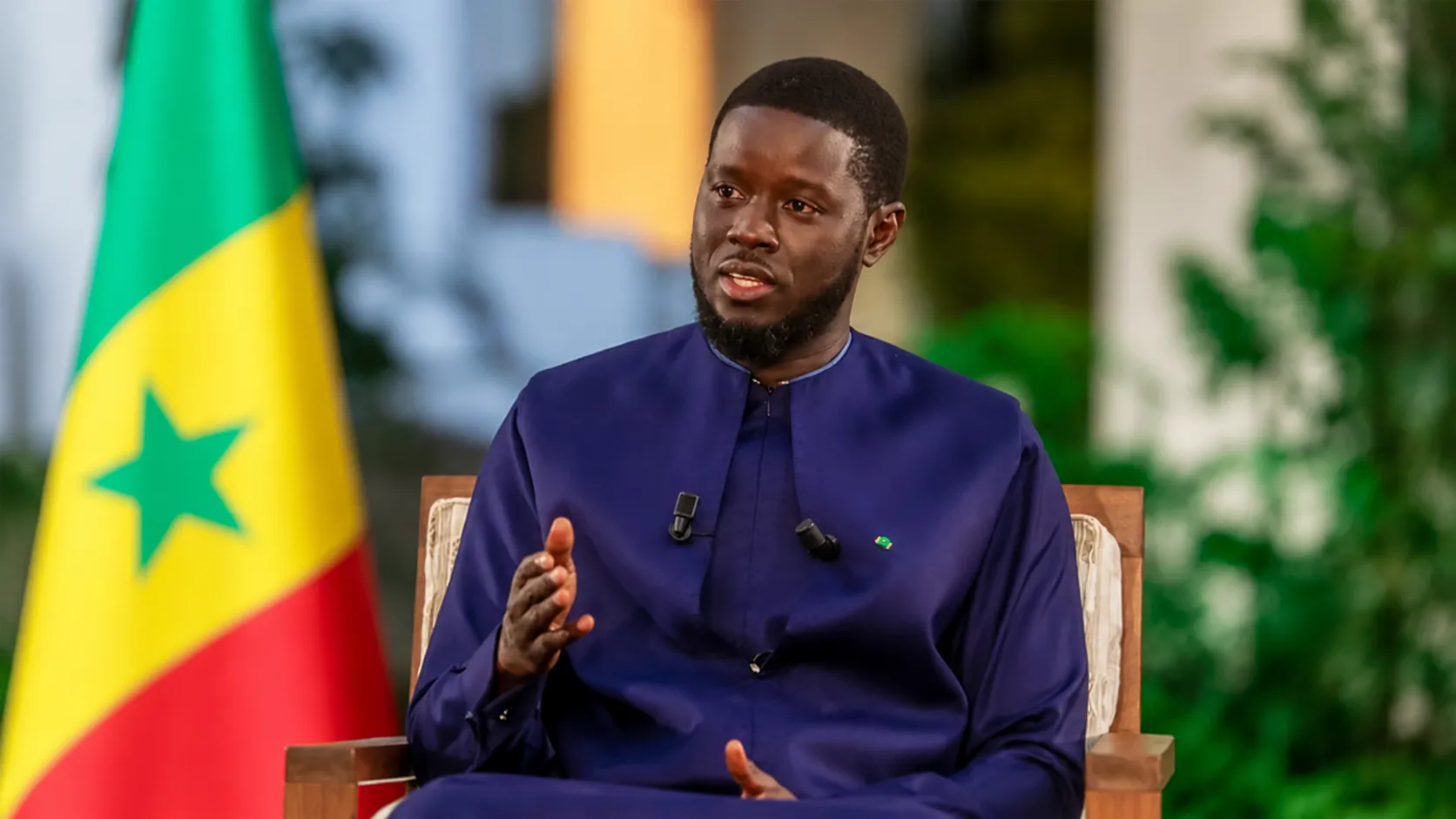
The slogan carried an entire campaign. “Diomaye mooy Sonko,” the Pastef militants chanted during the presidential election in March 2024. It then embodied the unity of a political project born in opposition to Macky Sall and represented by two complementary figures: the charismatic leader Ousmane Sonko, barred from competing, and Bassirou Diomaye Faye, his chosen companion in the struggle to carry the colors of the sovereignist camp.
Two years later, this political equation is shattered. President Faye has dismissed Ousmane Sonko from the Prime Minister position, appointed a new head of government, and set up a team that Pastef officially refuses to recognize. Thus, Senegal enters a period of internal cohabitation within the former presidential camp, with a head of state in the Palace, a former Prime Minister at the helm of the National Assembly, and a majority party that no longer officially participates in the executive.
The rupture of a tandem that arrived in power together
The political history between Bassirou Diomaye Faye and Ousmane Sonko does not begin with the 2024 presidential election. The two men met in the tax administration before engaging together in building Pastef. Faye, a tax inspector, gradually became one of Sonko’s trusted men, eventually taking on the role of secretary-general of the party.
When Sonko was sidelined from the presidential race, Faye emerged as the natural substitute candidate. He was presented as the political extension of the Pastef leader. His election in the first round on March 24, 2024, with an absolute majority, solidified less of an isolated personal victory than a transfer of legitimacy from Sonko and the party’s militant base.
But this victory already carried an ambiguity. Faye became president of the Republic, holding institutional legitimacy. Sonko, appointed Prime Minister, retained strong popular and partisan legitimacy. In practice, the Senegalese executive relied on two poles of authority: the head of state, elected by universal suffrage, and the party leader, considered by a significant part of the militant base as the true guardian of the rupture project.
This duality was long presented as a strength. It gradually became a source of tension. Differences increased regarding the management of reforms, the operation of the state apparatus, economic decisions, and relations with international financial institutions, especially in a context marked by the revelation of previously concealed debts.
A new government without official participation from Pastef
The turning point occurred in May 2026. Bassirou Diomaye Faye ended Ousmane Sonko’s functions and dissolved the government. A few days later, Ahmadou Al Aminou Mohamed Lo, an economist by training and former minister in charge of following the National Transformation Agenda “Senegal 2050,” was appointed Prime Minister.
The composition of the new government, published in early June, confirms the head of state’s intention to regain control over the executive. Several important figures associated with the former team left the government. The Lo cabinet appears more as a centering team, focusing on economic stabilization, public finances, and the resumption of dialogue with external partners.
In response, Ousmane Sonko announced that Pastef would not participate in the new government. This formula is politically heavy. It implies that the party that brought Faye to power now refuses to assume responsibility for the team appointed by the president. Even though some individuals from or close to the Pastef movement are included in the government, the party leadership officially distances itself from this team.
In this sense, one can say that Diomaye Faye is now governing without his own political party. Not because he has become a president without partisan background, nor because he has been formally excluded from Pastef, but because the party that constituted his initial political base no longer officially participates in governmental exercise.
This situation is all the more paradoxical as Pastef remains the main political force in the country. The party controls a large majority in the National Assembly, holding 130 out of 165 seats from the November 2024 legislative elections. Ousmane Sonko, for his part, has been elected president of the parliamentary institution. The former Prime Minister thus holds considerable leverage against the new government.
An unprecedented cohabitation within the same camp
Senegal is not in a classic cohabitation between a president and an opposition elected against him. The situation is more complex. The head of state and the parliamentary majority stem from the same original political camp, but their command centers are now separated.
On one side, Bassirou Diomaye Faye retains presidential legitimacy. The Constitution gives him the power to appoint the Prime Minister, dismiss him from office, and compose the government on the Prime Minister’s proposal. On the other side, Ousmane Sonko retains control of the majority party and presides over the National Assembly, an institution capable of influencing government action, controlling the executive, and, ultimately, bringing down the government through a motion of censure.
This configuration places the Lo government in a fragile position. To pass its legislation, drive its reforms, or implement sensitive budget measures, it will need to negotiate with a parliamentary majority that is no longer politically aligned with the president. The risk is not only institutional. It is also economic, in a country facing a crisis of confidence related to public debt and the suspension of a program with the International Monetary Fund.
The debt issue is one of the most sensitive points of this new phase. The Senegalese government must reassure financial partners, restore the credibility of public accounts, and find a sustainable budget trajectory. These choices may involve unpopular measures. Without clear support from Pastef, President Faye could find himself exposed to double pressure: that of the markets and financial partners, but also that of his own former political base.
Pastef re-centers around Sonko
The governmental rupture occurs at a time when Pastef is seeking to restructure itself. The congress held in Diamniadio in early June 2026 confirmed Ousmane Sonko’s centrality in the party apparatus. Reelected as the head of the formation, he now appears as the leader of a parliamentary majority that intends to fully play its oversight role.
This new posture marks a significant evolution. Pastef is no longer just the party accompanying governmental action. It now presents itself as a force of vigilance, pressure, and proposals, capable of supporting what it sees as aligned with its project, but also opposing directions it deems contrary to its initial commitments.
For Diomaye Faye, the challenge is therefore considerable. He must govern without fully breaking with the electorate that brought him to power, while building sufficient political autonomy to no longer rely entirely on Sonko and Pastef. This autonomy entails the “Diomaye Président” coalition and seeking new balances around the executive. However, this base remains less structured than Pastef’s militant machine.
The issue goes beyond personal rivalry between the two men. It touches on the very nature of the power stemming from the 2024 election. The rupture project, collectively carried against the former regime, must now survive the separation of its two main figures. The president wants to fully exercise his institutional authority. Sonko wants to preserve the political and doctrinal identity of Pastef. Between the two, the Lo government will have to try to exist.
Senegal thus enters a phase of governability under constraint. Bassirou Diomaye Faye remains president, but he no longer has the party apparatus that had been his electoral strength. Ousmane Sonko is no longer Prime Minister, but he controls the majority party and the National Assembly. This dissociation between the executive power and the political majority opens a period of uncertainty, where each reform, each budget, and each strategic arbitration could become a test of power balance.
Related Articles
 Benin: deputies summoned this Monday for the opening of an extraordinary budget session
 National Assembly of Benin: convocation of the second extraordinary session for September 7, 2026
 PAG 22026 – 2033: after Talon’s major projects, Beninese now await the social dividends of Wadagni
 Benin: the government resumes its Council of Ministers after the summer break
Comments
Comments load when you reach this section.