
Cowpea, between agroecological transition and gender justice
Overlooked and sometimes regarded as a “poor man’s grain” according to cereal-breeding specialists, cowpea (bean), a grain legume, contributes to food security in Africa and around the world. Its uses remain just as diverse, serving both human food and livestock feed. Yet some of its agroecological properties and its gender dimension remain little known.

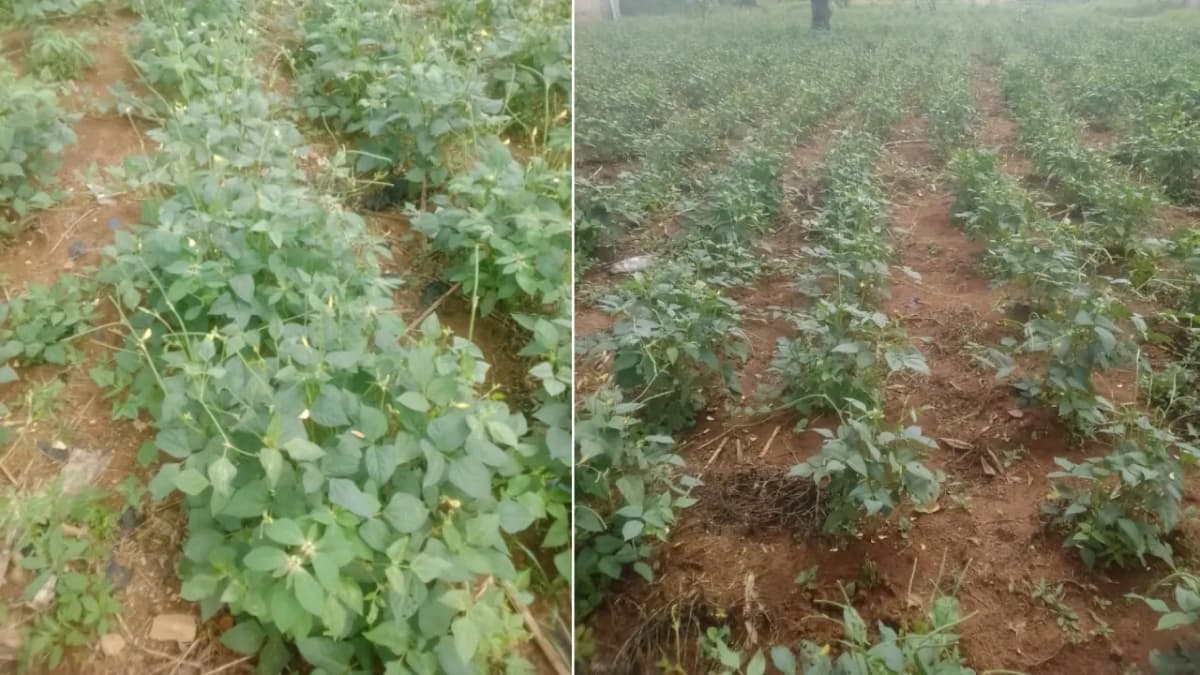
In Ouèdo, in the commune of Abomey-Calavi, more than 40 kilometres from Cotonou in southern Benin, on this morning in March 2026, Bienvenu Bonou proudly shows off his lush green cowpea field. More than a year earlier, at our first visit, he had been worried that the rains were late, having alternated maize with his cowpea harvest. “That harvest had been good,” he says.
“The current state of the soil’s fertility calls for growing cowpea, or groundnuts, here. Their roots and leaves, which rot into the soil after harvest, allow the land to regain its fertility. When you plant maize afterwards, it grows well,” says the farmer, in his forties and a father, speaking in the local Fon language.
In Gbétagbo, Zè, Torribossito and the surrounding agropastoral localities on the outskirts of Cotonou, food crops are grown on numerous plots. Most of the producers we met rely on chemical fertilisers to boost their yields. Few of them prioritise agroecological practices, including growing cowpea.
“Cowpea is a legume of the Fabaceae family, which contributes far more to soil fertilisation through the fixation of atmospheric nitrogen, via symbiosis with soil bacteria and nodulation. Our parents already knew that cowpea improves the soil, which is why they intercropped it with cereals like maize, sorghum and millet, long before anyone talked about climate change. Even without using fertiliser on certain soils here in Benin, cowpea growers can still achieve a certain level of yield,” says Symphorien Agbahoungba, a plant genetic improvement and biotechnology researcher at Michigan State University, based in Accra, Ghana, and a cowpea breeder.
“Cowpea is a plant that can improve soil fertility by supplying nitrogen. That’s why many producers grow cowpea without adding any inputs, since the plant is said to produce its own fertiliser. We have indeed observed that when cowpea is grown and alternated with a cereal, the cereal performs better. Cowpea does contribute to soil fertility,” said Elisabeth Pawindé Zida, senior research fellow in phytopathology at Burkina Faso’s Institute of Environment and Agricultural Research, in an interview.
Presenting a study titled “Genetic improvement of cowpea for West Africa and the USA” at the 7th World Cowpea Research Conference (WCRC) in Cotonou in September 2024, Dr Bao-Lam Huynh, a researcher and breeder at the University of California, Riverside, who focuses on host-plant resistance, marker-assisted selection and biofortification, said cowpea is used not only as a rotation and food crop, but also to enrich the soil in diversified fields.
An agroecological alternative to chemical fertiliser use
According to Dr Lydia Ndineleao Horn, coordinator of the Zero Emissions Research Initiative (ZERI) at the University of Namibia, cowpea’s nitrogen-fixing capacity plays an important role in reducing the use of nitrogen fertilisers.
“When soil acidity is very high, you’ll see that the roots fail to nodulate. Beyond that, when you apply too much fertiliser rich in organic matter, especially rich in nitrogen, nodulation is also weak,” explains Agbahoungba, among other conditions needed for effective fixation — properties specific to legumes, cowpea in particular.
He points out that excessive use of chemical inputs on the soil affects bacteria, and stresses the need to always apply the principle of restitution — adding organic matter, animal droppings in particular — since what is exported through the grain is not fully returned by the leaves left on the ground.
Added to these properties is crop rotation, which involves growing several — or at least two — different crops in succession on the same plot. There is also crop association, or polyculture, which involves planting several — or at least two — different crops at the same time on the same plot, with sowing or harvest dates that can be staggered.
“For very degraded soils, I don’t think cowpea can systematically replace fertiliser. What we also need is to place greater emphasis on organic manure, because mineral fertiliser alone doesn’t solve the problem either. It’s not just about poor soil fertility — it’s about the state of the soil itself. We need to improve the soil’s condition, and organic manure is what can really contribute to that,” says Zida.
In a country like Burkina Faso, what degrades soils the most is harsh weather, monoculture and intensive farming without fallow periods, she says. The latter two are seen on most family farms, where agricultural production is passed down from father to son.
In the fields, cowpea is reshaping women’s power
“It has been shown that, nutritionally, legumes are very important, and agroecologically they help maintain soil fertility, especially for smallholder farmers — women in particular, who often have small plots. Most of the time, these are the exhausted, abandoned plots that a husband leaves behind and hands over to his wife. We all know how much our mothers contribute financially to their households. Unfortunately, they don’t always have access to fertile land, despite their share of the national population,” says Louis Kokou Imorou, research assistant in the department of plant science and genetic improvement at the Faculty of Agronomy, University of Parakou, Benin.
According to his explanation, thanks to legumes like cowpea, women are able to restore the fertility of their land, since the crop demands fewer of certain nutrients and can fix atmospheric nitrogen.
Unlike cotton or maize, which do not yield well on depleted soils and which are the flagship crops of men, women prefer legumes, which are short-cycle crops — around two and a half months, three at most — and less labour-intensive, he says.
“I can say that in Burkina Faso, for example, many people sell cowpea to pay for their children’s schooling or to solve other problems. It’s a crop that people buy. Production doesn’t even cover our needs, and there is strong demand from abroad. Production is around 700 to 1,000 tonnes a year, and that’s not enough,” says Zida. Cowpea is categorised among what are known as “catch crops” — secondary crops that sell fairly well and provide producers with a source of income, she says.
According to the researchers interviewed, certain improved cowpea varieties require chemical treatments against pests. Hopes are pinned on the development of biological treatment products suitable for large areas, which could help prevent food poisoning caused by the use of chemical products.

Comments
Comments load when you reach this section.