
Benin: two months after leaving power, Patrice Talon takes the helm of the Senate shaped by himself
Former President of the Republic, Patrice Talon was elected, on Thursday, August 6, 2026, as the head of the Beninese Senate. This much-anticipated election marks his return to a major institutional role, just over two months after handing over power to Romuald Wadagni.

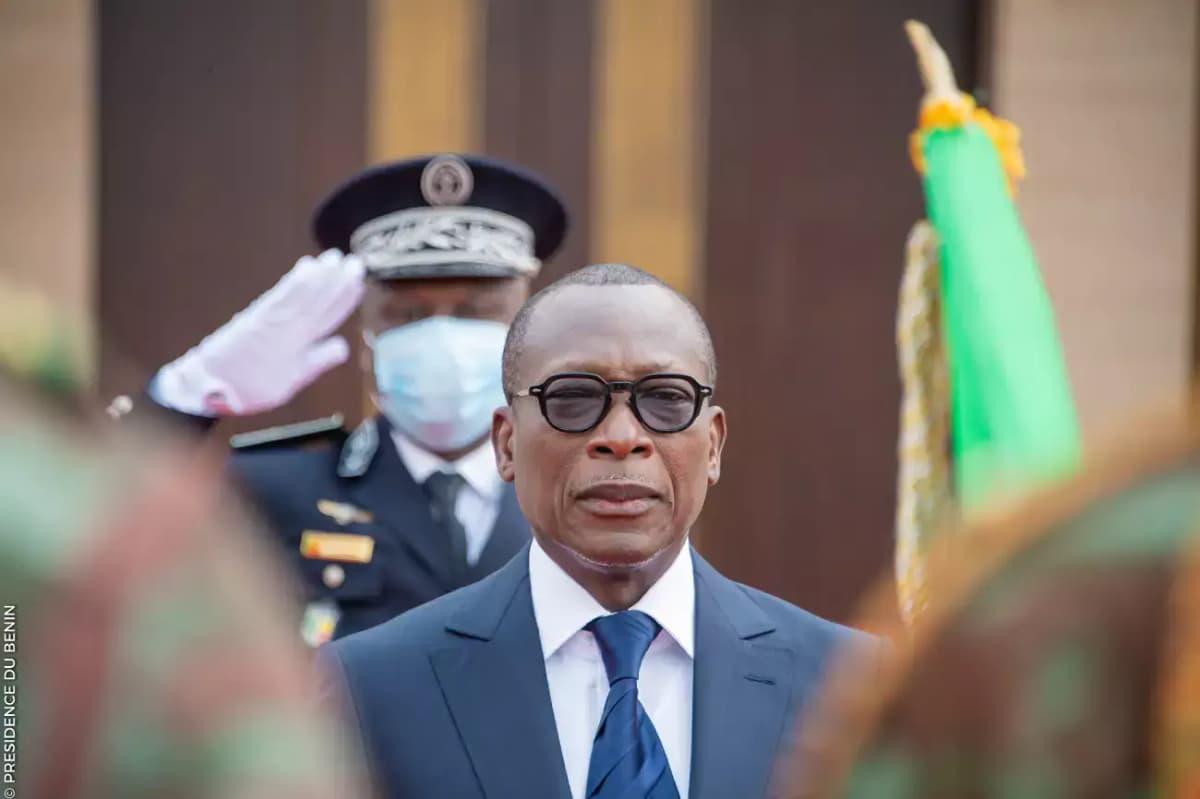
Patrice Talon is the first president of the Senate of Benin. The former head of state was elected on Thursday, August 6, 2026, following a closed-door conclave held at the Governors’ Palace in Porto-Novo. This appointment places the former president at the center of the new institutional architecture of the country. Patrice Talon left the presidency on May 24, 2026, after two consecutive terms, before becoming a member of the Senate by right.
His election comes as no surprise. The Constitution reserves the roles of president and vice-president of the Senate for members by right, which include former elected presidents of the Republic, the National Assembly, and the Constitutional Court who have met the requirements set by the text.
Before the vote, Élisabeth Pognon, former president of the Constitutional Court, invited the senators to observe a moment of reflection so that everyone could “question their conscience” before appointing the officials of the institution.
An elected office for five years
In accordance with Article 113-5 of the Constitution, the Bureau of the Senate consists of the president, the vice-president, and the rapporteur. These three officials are elected for a renewable five-year term. The deputy rapporteur is elected under the same conditions, but is not legally part of the Bureau.
The leadership of the new institution is as follows:
| Position | Holder | Profile |
|---|---|---|
| President | Patrice Talon | Former President of the Republic |
| Vice-President | Louis Vlavonou | Former President of the National Assembly |
| Rapporteur | Alassane Séidou | Former Minister of the Interior |
| Deputy Rapporteur | Adidjatou Mathys | Former Minister and designated Senator |
Created by a constitutional revision promulgated on December 17, 2025, the Senate is made up of members by right and designated individuals. The Constitution includes former elected presidents of the Republic, certain former presidents of the National Assembly and the Constitutional Court, as well as individuals who have held high civil or military responsibilities.
Fourteen individuals were designated on July 1, 2026, to complete the initial composition of the upper chamber. Ten were appointed by the President of the Republic, including five former leaders of the Defense and Security Forces, and four on behalf of the National Assembly.
The Senate notably includes among its members by right the former presidents Nicéphore Soglo, Boni Yayi, and Patrice Talon. It also includes former presidents of the National Assembly, such as Adrien Houngbédji, Bruno Amoussou, Antoine Idji Kolawolé, Mathurin Nago, and Louis Vlavonou, as well as former presidents of the Constitutional Court who meet constitutional criteria.
The new institution is tasked with regulating political life, ensuring institutional stability, and contributing to the preservation of national unity, democracy, and peace. It must also enforce the political truce and intervene in the examination of certain constitutional, electoral, or party operation laws.
The Senate can specifically make an objection before the promulgation of certain categories of laws and request a new deliberation of texts adopted by the National Assembly, excluding finance laws, settlement laws, and program laws.
A power structure shaped by Talon himself
The Beninese Senate was born from a constitutional revision initiated by Patrice Talon himself in November 2025, before he left power. This reform established bicameralism, extended electoral mandates to seven years, and created an upper chamber whose members are not elected by direct suffrage, unlike the deputies of the National Assembly. Decree No. 2026-107 of March 11, 2026, regarding the order of precedence, has placed the president of the Senate ahead of the president of the National Assembly in the state’s protocol hierarchy, symbolically establishing the supremacy of the new institution over the old. Several observers, including Beninese political commentators, believe that Talon designed this institution tailor-made, partly to protect himself against any challenges to his management over the ten years he spent in power.
Romuald Wadagni, chosen by Talon as his successor, describes their relationship as almost filial: “During this decade, we worked in total trust, like a father-son relationship, in constant contact.” This personal and political closeness facilitated a smooth transition without apparent rupture on May 24, 2026, with Talon publicly extending his best wishes for success to his successor. However, the effective establishment of the Senate revealed a latent source of friction: having failed to set up the upper chamber’s team before his departure, Talon left Wadagni with the delicate responsibility of activating an institution designed to exert control over the executive.
For a president accustomed to vertical and pragmatic governance, activating the Senate quickly meant accepting an institutional oversight over his economic reforms, while the composition of the chamber remained largely shaped by Talon’s legacy. This dilemma was resolved through a manifest continuity, as the appointments made by Wadagni in early July 2026 favored several former direct collaborators of Talon, such as Pascal Irénée Koupaki (former secretary general of the presidency), Alassane Séidou (former Minister of the Interior), and Fortuné Alain Nouatin (former Minister of Defense). This continuity suggests that Wadagni chose the path of accommodation rather than open confrontation with his mentor, at least during the institution’s installation phase.
Constitutionally, however, Talon’s influence remains limited. The President of the Republic possesses exceptional powers and cannot be sanctioned by the Senate, while only the National Assembly can authorize a procedure for impeachment or judicial proceedings against a head of state. Legal expert Gilles Badet, former secretary general of the Constitutional Court, emphasizes that the Senate should be viewed as a consultative institution and not as a rival counter-power to the executive, providing support rather than a direct threat to the presidency. This interpretation nuances the more alarming analyses that depict the Senate as an instrument of tutelage over Wadagni by his predecessor.
Talon-Djogbénou: A long-standing personal proximity, an institutional cohabitation to negotiate
Joseph Djogbénou has longstanding personal ties with Patrice Talon. A former lawyer for Talon, he notably defended him in 2014 in the so-called “attempt to harm the head of state” case and is considered one of the pillars of his inner political circle. This closeness was institutionalized when, in 2018, as president of the Constitutional Court, Djogbénou played a key role in an electoral process favorable to the presidential camp, before joining Talon’s government as Minister of Justice. Elected president of the National Assembly unanimously by the 109 deputies on February 8, 2026, succeeding Louis Vlavonou, Djogbénou thus embodies a direct political continuity with the Talon era, now transposed to the head of the legislative power.
Unlike the Talon-Wadagni relationship, marked by a vertical mentorship dynamic, the Talon-Djogbénou link is rooted in a different institutional issue, that of cohabitation between two chambers of Parliament, one of which (the Senate) now has protocol precedence over the other. Djogbénou himself sought to defuse concerns about a rivalry between the two chambers, stating that “the constitutional range between the Senate and the National Assembly does not position the two bodies in an institutional duel,” but rather “a duo in a complementary relationship.”


Comments
Comments load when you reach this section.