
Benin-Niger: security, transit, disputes… what to take away from the discussions in Cotonou.
The Beninese and Nigerien expert committees completed 48 hours of discussions on the reopening of the common border on Sunday, June 21, 2026, in Cotonou. Both delegations report having agreed on security, economic, and legal commitments, but the effective resumption of traffic remains contingent upon the ratification of the conclusions by Presidents Romuald Wadagni and Abdourahamane Tiani.

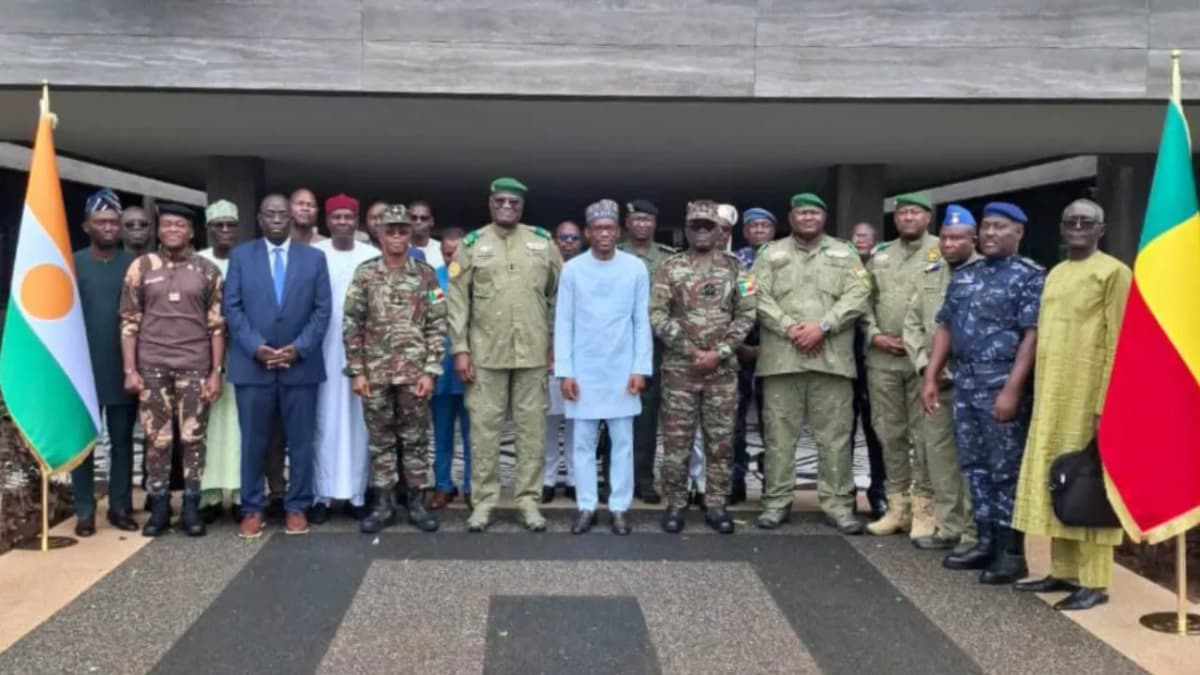
The Beninese and Nigerien expert committees tasked with examining the conditions for reopening the common border concluded their joint work on Saturday, June 21, in the early afternoon in Cotonou, after 48 hours of meetings. The two delegations, led by Major General Mohamed Toumba, Nigerien Minister of State for Interior and Public Security, and by Beninese Minister of African Integration, Olushegun Adjadi Bakari, reached an agreement on a set of security, economic, and legal commitments. These conclusions must be ratified by Presidents Romuald Wadagni and Abdourahamane Tiani to come into force.
At the end of the discussions, General Toumba stated that both parties had upheld their commitments and “secured the security priority.” He added that the foundations for economic and legal normalization had been laid and called for the ratification of the agreements “as soon as possible” so that they mark “the beginning of a new era.” Minister Adjadi Bakari, for his part, praised the spirit of unity, asserting that after 48 hours of work, the two delegations formed “one delegation with a single objective, to revive that age-old love and bond between our two peoples.”
The Security Aspect
The Nigerien delegation formally notified two prerequisites that Niamey considers non-negotiable. The first pertains to the signing of a bilateral defense and security agreement based on the principle of non-aggression, prohibiting the use of the territory of either state to conduct hostile actions or destabilization against the other. Niger seeks to obtain legal guarantees concerning its southern border in response to accusations made since 2023, which Cotonou has denied, alleging that Benin hosts foreign military bases.
The second prerequisite concerns transparency regarding foreign military deployments near the Nigerien borders, accompanied by the establishment of a joint intelligence cell. The stated goal is to share information in light of the threat from armed groups operating on both sides of the border, in northern Benin and southwestern Niger.
The Economic and Legal Aspects
Beyond security, both parties have included four principles in their common commitments aimed at framing the resumption of exchanges. General Toumba cited the exemption of transit taxes, the prohibition of the consumption of goods in transit, the revision of fees, and the resolution of disputes. These principles aim to restore a predictable economic framework for operators from both countries.
Although no explicit reference was made to the pipeline linking the Agadem oil fields to the Sèmè-Kpodji terminal, the exemption from transit and the prohibition of consumption directly concern the arrangements for transporting Nigerien crude through Beninese territory. The blockage of oil shipments, decided by President Talon in May 2024 in retaliation for the border closure, had been the peak point of contention between the two countries. The pipeline, approximately 2,000 kilometers long with an estimated investment of six billion dollars, serves as the main export route for Nigerien crude.
The resolution of disputes could also involve the matter surrounding the arrest in June 2024 of five Nigerien nationals charged in Benin with endangering state security, a case that had heightened tensions between the two capitals.
A Process Led in Three Weeks
The rapprochement began on June 2, when President Wadagni, invested nine days earlier, made an official visit to Niamey. The two presidents issued a joint communiqué outlining nine points and created an expert committee with a fifteen-day mandate. On June 16, a joint communiqué signed by Ministers Adjadi Bakari and Bakary Yaou Sangaré, head of the Nigerien diplomacy, announced the conclusion of the first cycle of work conducted separately and announced the joint meeting.
General Toumba, a member of the National Council for the Safeguarding of the Homeland and a figure of the junta, left Niamey on June 19 after a framing meeting at the office of Prime Minister Ali Mahamane Lamine Zeine. His trip to Cotonou marks the first high-level Nigerien initiative on Beninese soil since the crisis.
The next step is the ratification of the conclusions by the two heads of state. No reopening date has been set, but the statements from the two ministers, choosing the language of renewed brotherhood and urgency, signal a desire to accelerate the timetable.


Comments
Comments load when you reach this section.