
Benin: in eight days, Romuald Wadagni speaks to the four military regimes of the sub-region
By multiplying visits to Niamey, Ouagadougou, Bamako, and Bissau in the first weeks of his term, Romuald Wadagni introduces a clear shift in Beninese diplomacy. Far from the confrontational stance seen under Patrice Talon, the new president places Cotonou in a dialogue position with the West African military regimes, in the name of economic, security, and regional interests.

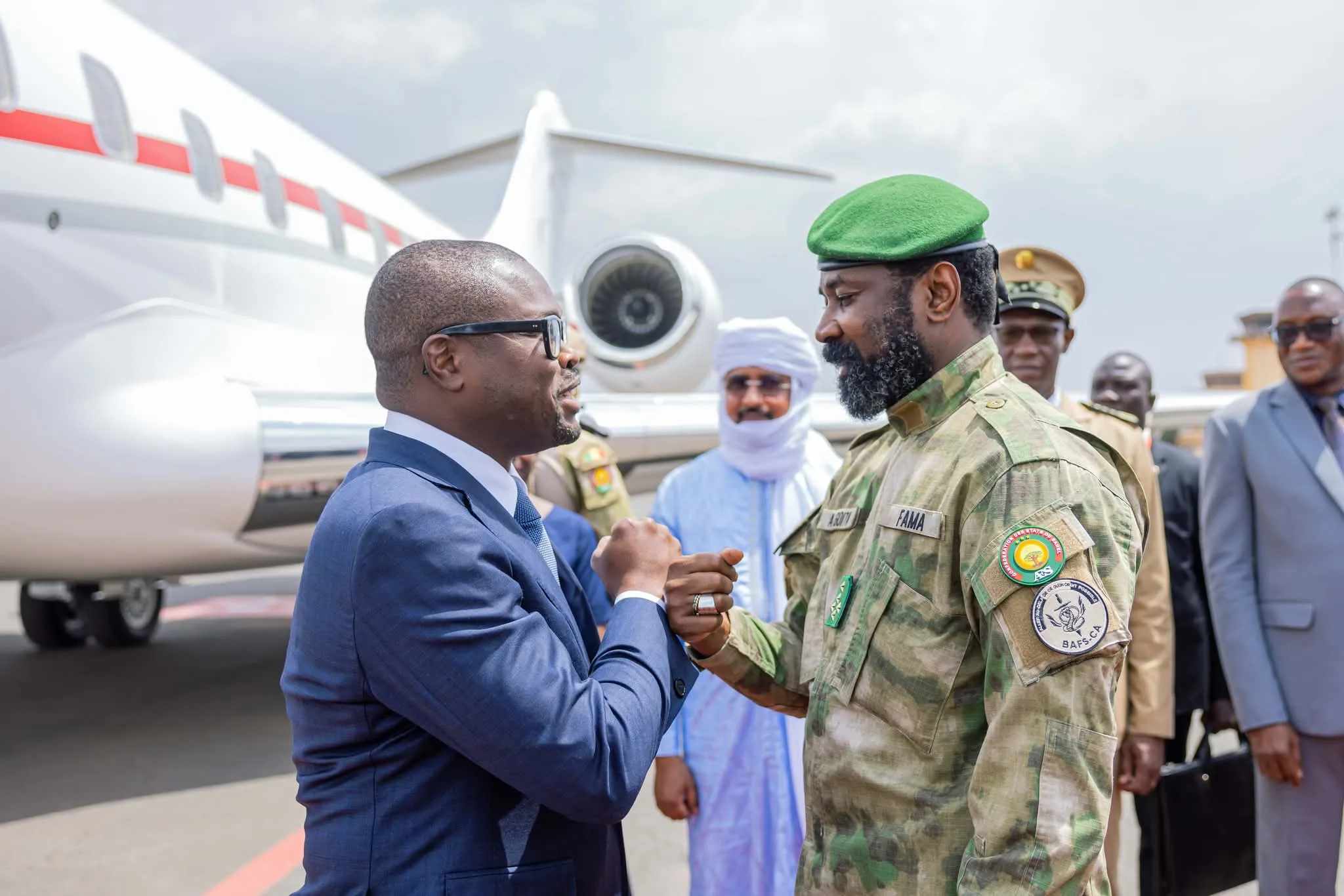
In less than three weeks at the head of the state, Beninese President Romuald Wadagni has made West Africa his first diplomatic destination, focusing on four capitals led by military leaders. Niamey, Ouagadougou, Bamako, and Bissau featured in the agenda of a double tour initiated in early June, alongside civilian partners such as Nigeria, Togo, Ivory Coast, and Senegal. This choice contrasts with the end of his predecessor Patrice Talon’s term, characterized by an open confrontation with neighboring Sahelian juntas.
Inaugurated on May 24, 2026, Mr. Wadagni first visited Nigeria, Niger, Burkina Faso, Togo, and Ivory Coast during the week of June 1. On June 9, he began a second series of visits to Senegal and then to Mali, where he was received in Bamako by the transitional leader, General Assimi Goïta, before a final stop in Guinea-Bissau. The Beninese presidency presents these trips as a tour among the member states of the UEMOA, sharing with Benin a common currency and central bank, focusing on economic cooperation, regional solidarity, and security issues.
The highlight is not the pace, which is sustained, nor the format, which is traditional for a new term. It lies in the nature of the interlocutors. Of the ten stops covered, four involve governments resulting from coups: the three states of the Alliance of Sahel States (AES), now formed into a confederation after their departure from ECOWAS, and Guinea-Bissau, where General Horta N’Tam has been leading a one-year transition since the coup on November 26, 2025. Analysts argue that these meetings signal a thawing of the very tense relations between Cotonou and the military regimes of the AES.
The Break with the Talon Sequence
The significance of this gesture is measured against the backdrop of the crisis that pitted Benin against Niger under the previous presidency. After the coup d’état on July 26, 2023, against Mohamed Bazoum, Cotonou applied ECOWAS sanctions and closed its border. Lifting these sanctions did not suffice to normalize relations: Niamey kept its border closed, accusing Benin of hosting foreign bases intended to destabilize it, which Cotonou denied.
The dispute peaked around the pipeline linking the Agadem fields in Niger to the Sèmè-Kpodji terminal on the Beninese coast. Spanning nearly 2,000 kilometers, approximately 675 of which are on Beninese territory, the project represents an investment of around six billion dollars and a targeted capacity of up to 90,000 barrels per day, equating to potential revenues for Niamey of up to 12.36 billion euros, according to World Bank estimates cited by various media. In May 2024, Mr. Talon blocked the loading of Nigerien crude as long as the border remained closed. In June 2024, the arrest by Beninese authorities of five Nigerien nationals, charged with endangering state security, heightened tensions to their peak and led Niamey to consider alternative evacuation routes.
This dynamic of confrontation is what the new presidency seeks to close. A former Minister of Economy and Finance from 2016 to 2026, a technocrat without party affiliation, Mr. Wadagni approaches the regional issue with a different framework than that of Mr. Talon, who mixed sovereign assertiveness with a logic of reciprocity. Mali, represented at the Beninese inauguration by its foreign minister Abdoulaye Diop, had then set as a condition a relationship based on respect for state sovereignty, a recurring formulation from the AES authorities.
An Economic Logic Above All and the Security Imperative in the North
Behind the symbol, Benin’s interest is tangible. The port of Cotonou is one of the main maritime gateways to the Sahelian hinterland for landlocked countries facing high transport costs and logistical challenges. For Bamako, whose preferred corridors pass through Dakar, Abidjan, San Pedro, or Lomé, the Beninese coastline offers a possible diversification rather than an immediate substitution, according to the agency APAnews, which describes the movement as a pragmatic rapprochement.
For Cotonou, the revival of transit, whether for goods or, eventually, for Nigerien crude, is crucial for the profitability of heavy infrastructure funded partly with public funds. The diplomatic sequence thus fits into an acknowledged economic calculation, consistent with the financial profile of the head of state and with Benin’s continued presence in the West African monetary space. Framing by the UEMOA, and not merely by the Sahelian geography, allows the stages with the juntas to be presented as part of a broader tour without making it a political alignment.
The second driving force is security. Northern Benin has faced pressure from armed groups operating from the border areas of Burkina Faso and Niger for several years. The Pendjari and W parks have been the scene of deadly attacks, and the break in dialogue with the governments of Ouagadougou and Niamey deprived Cotonou of cooperation channels for intelligence and border surveillance.
The restoration of direct contact with the capitals of the AES addresses this constraint. The two parties do not share the same understanding of the Sahelian crisis, but they face a common threat whose movement ignores diplomatic ruptures. Cooperation on intelligence, combating trafficking, and securing border areas is among the avenues opened by these exchanges, although no concrete arrangements have been made public at this stage.


Comments
Comments load when you reach this section.